While working on improving AI agent-readiness for the Chainlink Labs documentation platform, I explored exposing documentation in machine-readable markdown directly from canonical routes.
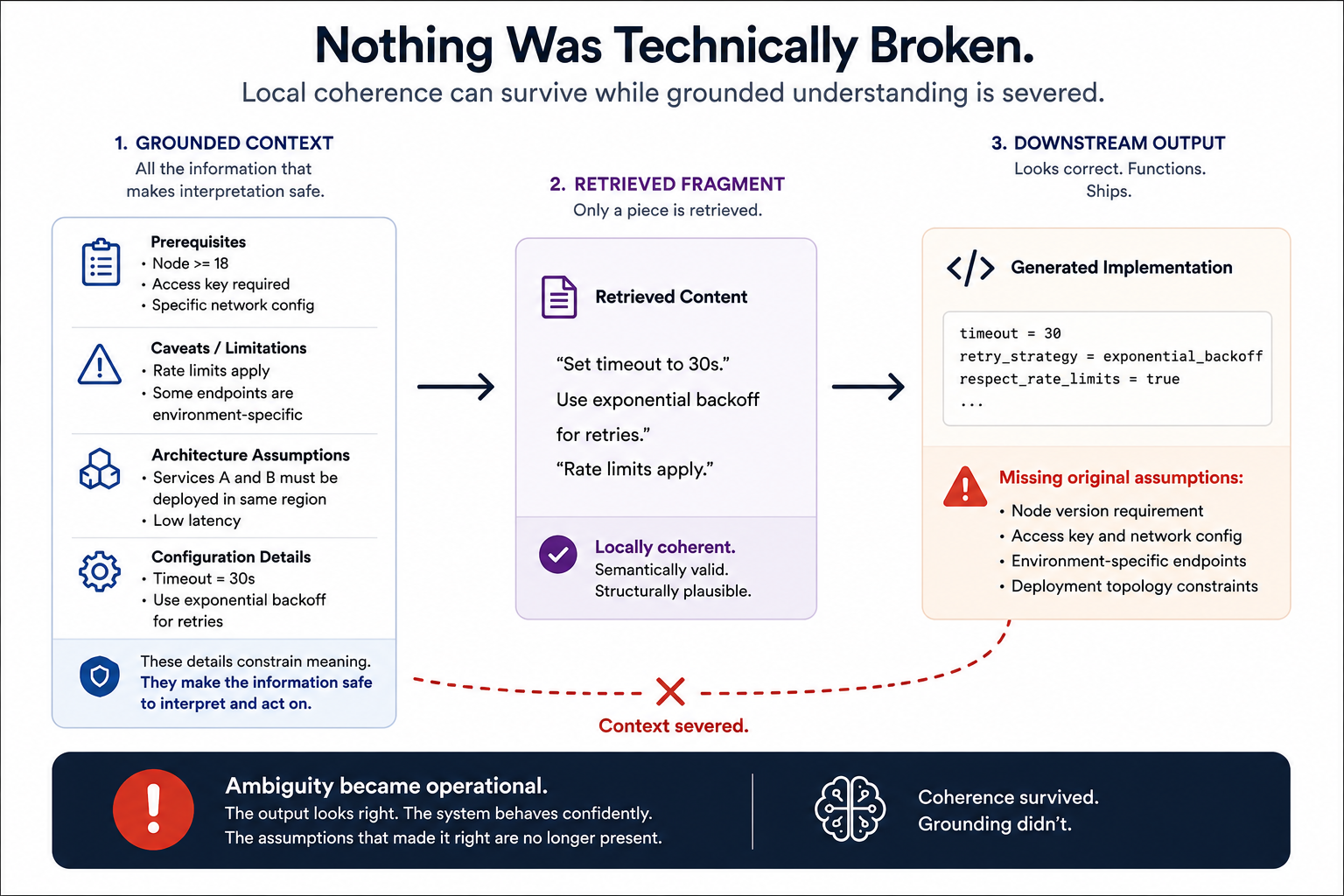
At first, the change seemed additive. It wasn't.
The original goal was relatively straightforward: make documentation easier for AI systems and retrieval-based tooling to consume reliably. Instead of forcing models to parse large amounts of HTML, navigation structure, layout wrappers, and dynamically rendered UI elements, I wanted to provide deterministic, structured markdown that could be retrieved cleanly and interpreted more consistently.
Conceptually, the change sounded simple. Humans would continue using the existing documentation experience. Meanwhile, machines would simply gain a cleaner machine-readable layer alongside it.
But the moment the documentation started being treated as machine-consumable infrastructure instead of purely human-readable communication, the surrounding system behavior started changing too.
Routes that had previously behaved deterministically became conditional. Validation assumptions that had quietly existed across tooling pipelines stopped holding consistently. Static checks that previously signaled broken pages suddenly produced false negatives because route behavior now depended on request context and runtime interpretation.
Nothing was technically "broken." The documentation still rendered. The routes still existed. The outputs still looked structurally correct. But operational assumptions underneath the system had started drifting.
What made the experience especially interesting was that the implementation guidance itself was genuinely good. The agent-readiness documentation and scoring guidance provided clear recommendations for improving machine retrieval behavior, and much of it was operationally useful. But it also became obvious fairly quickly that the scoring system was implicitly optimizing for a very specific architectural model.
Achieving a higher score through content negotiation would have required shifting significant portions of our documentation platform from a purely static architecture toward more dynamic SSR-driven behavior. That is not a small implementation detail. It is a fundamental architectural tradeoff with downstream implications for performance, operational complexity, validation behavior, caching assumptions, deployment workflows, and long-term system maintenance.
What mattered operationally was not blindly optimizing for a metric. It was understanding the underlying problem the metric was approximating and solving for it in ways that remained compatible with the realities of the system itself.
That realization reinforced something broader happening across AI-mediated systems: increasingly, optimization targets are not just influencing outputs. They are influencing architectural decisions upstream.
AI does not simply change how information is generated. It changes how information is interpreted, retrieved, operationalized, and propagated through systems that increasingly treat documentation as authoritative context.
Historically, most documentation was written with an implicit assumption: the primary consumer was human. Humans navigate context differently than machines do. A human reader encountering ambiguity will often pause, ask questions, infer intent from surrounding information, or recognize when something feels incomplete. Even misunderstandings tend to fail somewhat locally.
Machine retrieval systems fail in fundamentally different ways. They retrieve fragments. They flatten context. They inherit assumptions silently. And increasingly, they operationalize documentation without understanding where contextual boundaries may already have started breaking down.
That changes the nature of documentation failure entirely.
Historically, documentation failures were often easier to identify because the misunderstanding itself became visible relatively quickly. Someone implemented the wrong parameter, misunderstood a prerequisite, or hit behavior that clearly contradicted expectations. The friction surfaced the ambiguity.
Machine-mediated retrieval systems can preserve the appearance of correctness much longer. A retrieved fragment may still contain valid terminology. The implementation steps may still appear internally consistent. The surrounding output may still look professionally structured and technically credible. In many cases, the system is not inventing information outright. It is recombining partially correct information while silently losing the contextual boundaries that originally constrained its meaning.
The operational danger increasingly comes less from obviously incorrect outputs and more from structurally plausible outputs that inherit assumptions nobody explicitly realized were being carried forward.
In practice, this creates a very different relationship between documentation and implementation behavior. The documentation is no longer simply guiding a human reader through a workflow. It is increasingly functioning as machine-consumed operational context feeding retrieval systems, AI-assisted tooling, onboarding workflows, support systems, and downstream automation layers that may never fully understand the constraints surrounding the information they retrieved.
And once that starts happening, ambiguity no longer remains confined to a single reader misunderstanding something. It propagates.
The original documentation author may have intended a section to be interpreted alongside surrounding context, prerequisite knowledge, architectural caveats, or adjacent implementation guidance. A retrieval system may instead isolate a fragment, elevate it as authoritative context, and operationalize it independently from the boundaries that originally made it safe to interpret correctly.
That is what makes these failures harder to detect, harder to debug, and in many cases, harder to even recognize as documentation failures in the first place.
Increasingly, this means documentation quality is no longer just a communication concern. It is becoming an infrastructure concern.
The problem is no longer simply whether a human can eventually understand the material. The problem becomes whether information can survive retrieval, fragmentation, recombination, and machine interpretation without silently inheriting ambiguity along the way.
For a long time, documentation was primarily evaluated by how effectively it helped humans navigate complex systems. Increasingly, documentation is also being evaluated by whether machines can reliably retrieve, interpret, and operationalize information without losing the contextual boundaries that made the information trustworthy in the first place.
Once documentation becomes machine-consumed infrastructure, clarity stops being primarily a communication goal. It becomes a systems reliability requirement.