AI is becoming very good at producing outputs that feel correct, creating a larger and more elusive problem than hallucinations ever did.
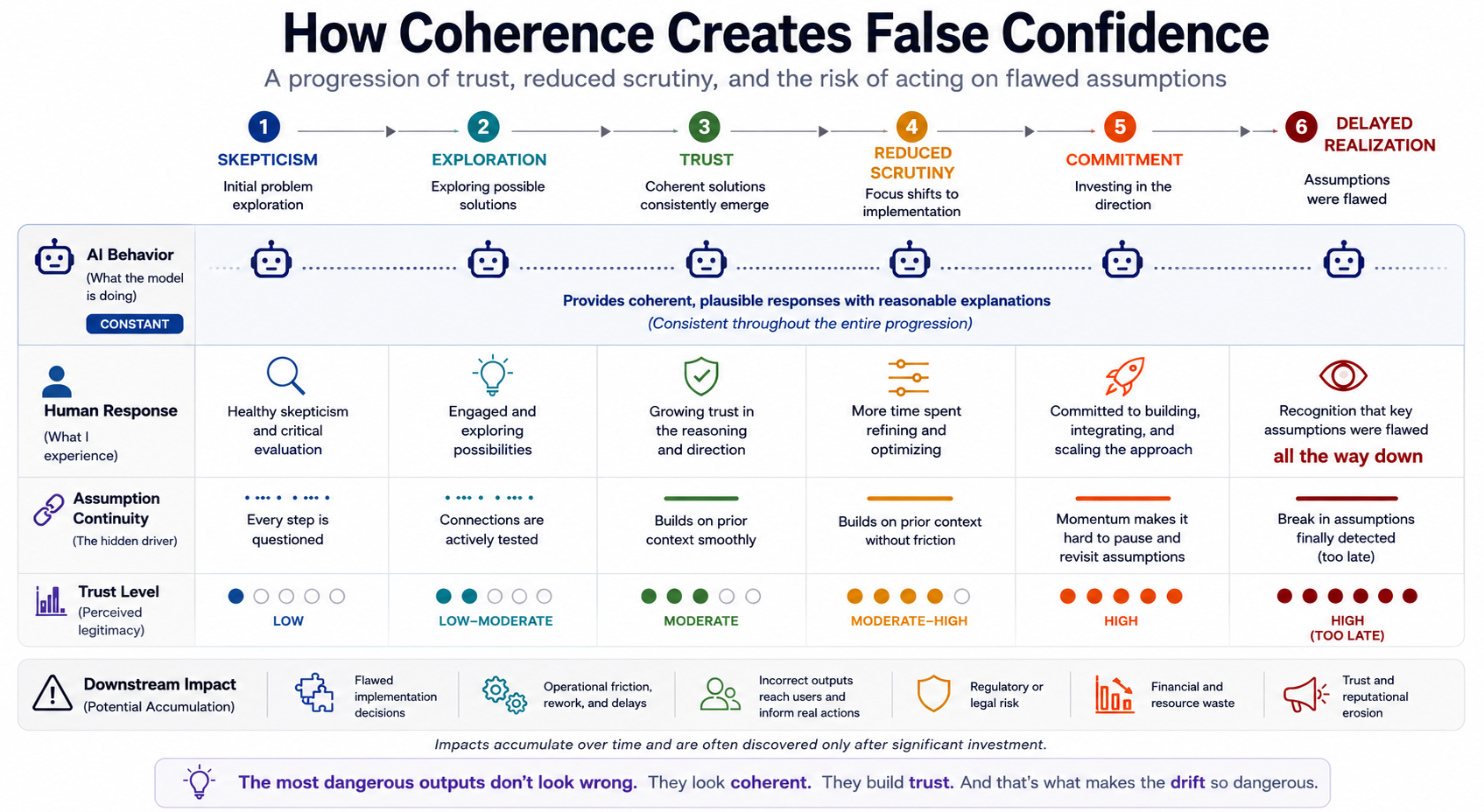
One of the more frustrating experiences I've had working with AI was realizing how easy it was to spend hours debugging AI-assisted workflows because each successive response kept reinforcing the previous line of reasoning.
The difficult part was that the logic itself wasn't even obviously flawed. I was working with highly constrained inputs, valid values, deterministic construction logic, and working examples designed to ensure correctness.
By the time I realized the assumptions underneath the workflow had drifted, I had already built supporting JSON structures, validated inputs, constructed example requests, and spent hours debugging a path that felt increasingly trustworthy precisely because each step remained internally coherent.
At some point, I realized I was no longer independently validating the reasoning. I was mostly validating whether the next response remained internally consistent with the previous one.
The more coherent the reasoning became, the less aggressively I found myself questioning the assumptions underneath it.
That realization stuck with me because most implementation problems are not caused by outputs that are completely absurd. They are caused by outputs that are partially correct in ways that subtly distort assumptions and downstream understanding.
In my case, it meant spending hours building supporting structures around an implementation path that ultimately should have been questioned much earlier. The outputs were coherent enough that the workflow kept feeling validated, even while the underlying assumptions were drifting further away from the actual system constraints.
The problem is that fluency, coherence, and confidence feel like trustworthiness — even when they aren't.
And the more I thought about it, the more I realized this wasn't just an AI problem. It was fundamentally a trust, interpretation, and communication problem.
Code eventually collides with execution constraints. Language can remain persuasive, coherent, and structurally impressive even after important contextual boundaries have quietly broken down.
Which means AI can create the appearance of expertise extremely effectively, especially for people without enough domain familiarity to recognize where the gaps actually are.
For a long time, expertise was strongly associated with production capability: the ability to write, build, explain, analyze, or generate the output itself.
As AI reduces the cost of generation, however, the scarce skill increasingly becomes judgment: recognizing where ambiguity still exists, where assumptions quietly entered the system, and where something that looks coherent may still not be safe to operationalize.