Recently, someone questioned whether a piece of writing I shared was actually my own or just AI-generated content presented as original work.
The accusation certainly stung, especially at a time when AI adoption was increasingly being encouraged professionally. But what hit me harder was the realization that came afterward.
Writing has always been one of the skills I felt most confident in professionally. Prior to technical writing for SaaS and B2B companies, I had spent years writing scientific publications, academic research, and structured analytical work where clarity and precision were treated as professional requirements.
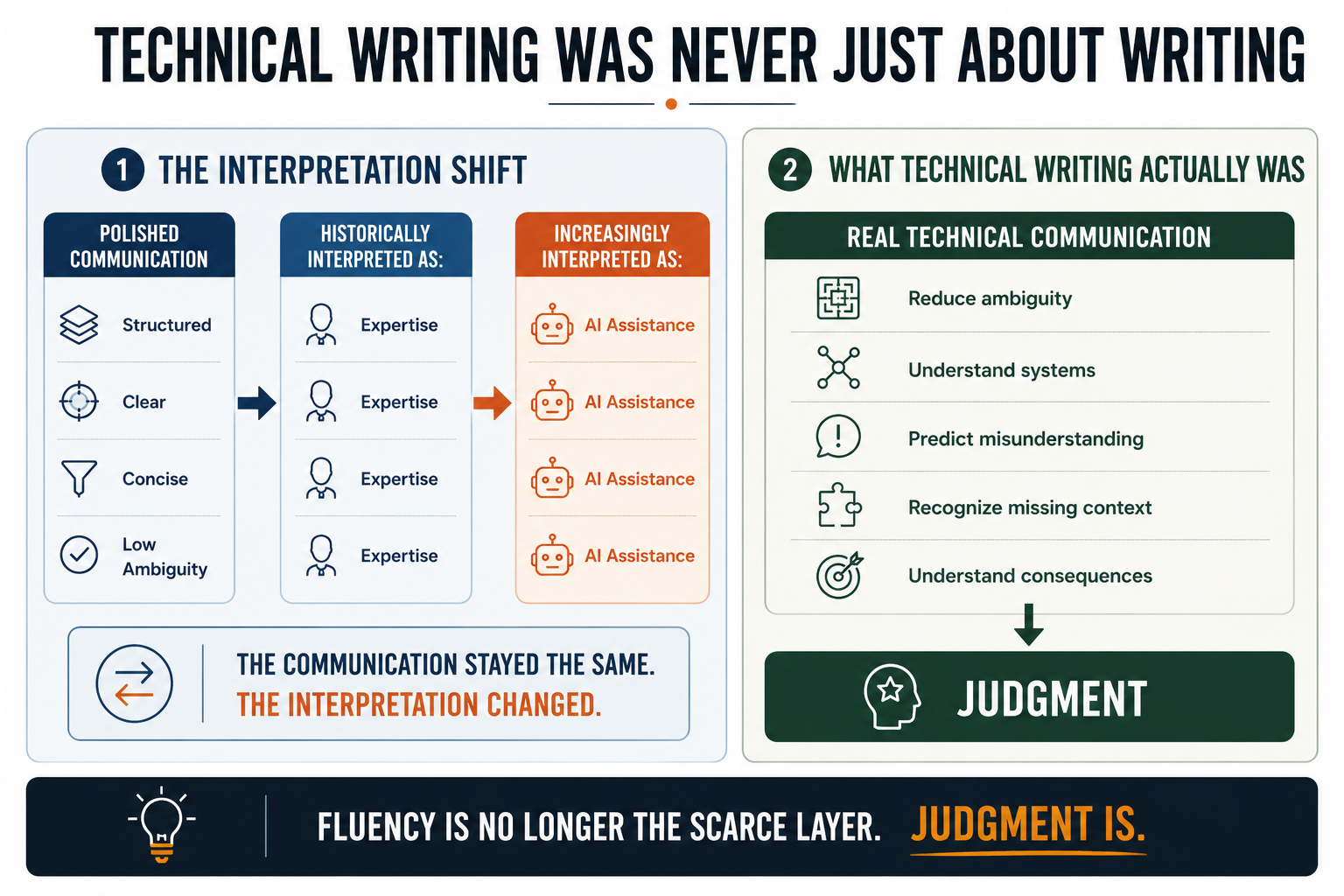
Many of the traits that triggered the suspicion were the same communication habits I had intentionally developed over years of academic and professional writing: structured reasoning, coherent organization, concise synthesis, emotionally neutral explanation, reduction of ambiguity.
Historically, those traits were associated with rigor, expertise, and intentionality. Now, those same traits are increasingly read as evidence of automation.
The longer I thought about it, the more I realized this wasn't really about me at all. AI is changing not only how humans produce communication, but also how humans interpret communication itself.
Fluency implied effort. Coherence implied expertise. Structured communication implied real understanding.
AI destabilized that relationship almost overnight, and we now live in an environment where highly plausible communication can be generated instantly and at massive scale.
As a result, people are unconsciously changing how they evaluate information and expertise. I notice people searching for signals of humanity rather than signals of polish. Roughness feels more authentic. Conversational language feels more trustworthy than highly synthesized writing. Emotional texture feels more "real" than carefully structured communication.
Not because good writing suddenly became bad, but because polished communication alone no longer reliably proves cognition, experience, or understanding.
And I think this creates an identity crisis for people whose professional lives revolved around communication, synthesis, explanation, and analytical clarity.
A lot of us spent years refining communication skills that AI can now imitate remarkably well at the surface level. That realization can feel destabilizing if we mistakenly believe the writing itself was the entire skill.
If we're honest, the writing itself was often just the final output of the deeper source of our expertise.
In technical communication, for example, the real work was never simply producing polished prose. It was reducing ambiguity, understanding systems deeply enough to explain them accurately, predicting where interpretation might break down, recognizing missing context, validating whether something was operationally trustworthy, and understanding the downstream consequences of wording and structure.
The difference between "may experience intermittent delays" and "requests can fail under high load" is not just stylistic. It changes implementation behavior. It changes operational expectations. It changes trust.
I've also noticed society interprets AI assistance very differently depending on the domain. Engineers using AI to accelerate coding workflows are often viewed as productively leveraging modern tooling. Writers and communicators using AI-assisted workflows are more likely to have their originality or expertise questioned.
I suspect part of this comes from the fact that software can eventually be validated behaviorally through execution. Communication itself often functions as both the artifact and the trust signal simultaneously.
That distinction matters because AI is not just changing productivity. It is changing the relationship between communication, trust, expertise, and authenticity.
Maybe the real expertise was never the ability to produce polished communication itself. It is the ability to responsibly translate complexity in environments where misunderstanding has real-world consequences.
Because in the age of AI, fluency is no longer the scarce layer. Judgment is.