In brief: Writers are changing their work to avoid AI accusations. An analysis of 465 comments on a single LinkedIn post reveals a much bigger disagreement about authorship, quality, and what counts as writing.
A Wall Street Journal article described writers leaving typos in their work and avoiding em dashes to escape suspicion. A LinkedIn post about the article sparked a discussion that went well beyond writing quirks, touching on AI detection, authorship, and what constitutes acceptable assistance.
As both a participant in the discussion and someone directly affected by these questions, I examined 465 comments to understand the positions people were taking and the distinctions they were making.
The findings reflect this particular comment thread, not what writers generally believe.
It's Not Just Pro-AI vs. Anti-AI
The first and most obvious observation was how little of the discussion fit the familiar pro-AI versus anti-AI divide. People were defending tools they didn’t entirely trust, questioning accusations without defending AI, and discussing writing without taking a position on the technology at all.
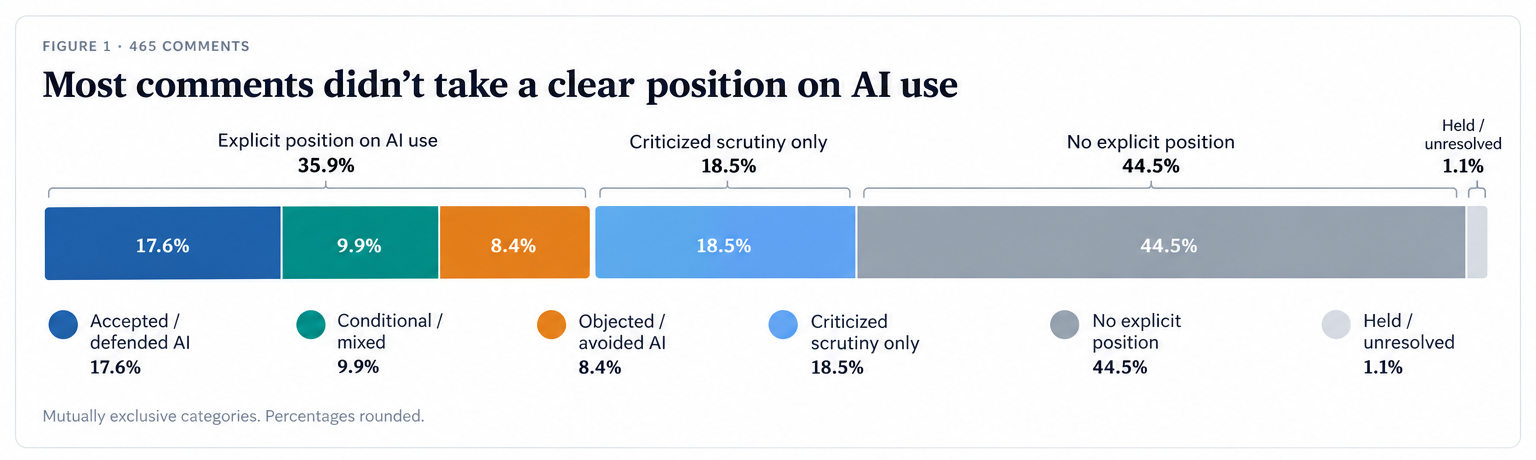
Only 35.9% of comments explicitly took a position on AI use. Another 18.5% criticized scrutiny of writers without endorsing AI, while 44.5% expressed no explicit position.
That last category was not discarded or treated as uninformative. The comments were also analyzed for the issues they raised, regardless of whether they endorsed or opposed AI use. A comment could contribute to the findings on authorship signals, detector reliability, writing quality, or professional expectations without taking a position on the technology itself.
Criticizing Scrutiny Isn't the Same as Defending AI
Two distinctions stood out:
- Accepting AI doesn’t mean admiring its writing. One commenter who accepted AI use asked, “Have you seen how it writes?!?!?” Another called it “fairly incompetent” while praising its usefulness for proofreading, checking consistency, and brainstorming. A tool can be useful without being good at everything.
- Questioning accusations doesn’t mean endorsing AI. Commenters challenged judgments based on familiar writing patterns or described being accused of using AI despite writing the material themselves. Their concern was how the work was being evaluated, not necessarily whether AI assistance was acceptable.
One professional writer described rewriting a draft after a client employee accused them of submitting AI-generated work. Before resubmitting, they ran the new draft through three detectors, which returned three remarkably different results:
11% AI · 71% AI · 100% human
Another commenter reported having to produce extensive documentation to defend academic work completed years earlier. Neither account establishes how often such situations occur, but both illustrate what can happen when a judgment about authorship becomes something a writer has to disprove.
We're Not All Arguing About the Same Thing
Even when commenters appeared to be discussing the same issue, they weren’t necessarily evaluating the same thing. Someone questioning an AI detector wasn’t making the same argument as someone criticizing AI-generated prose. And neither was necessarily addressing the concerns of someone worried about losing writing skills.
Looking at the specific claims made in the comments helps explain why these discussions can become so tangled.
Different Concerns, Different Standards
Consider the different questions hiding inside what looks like one argument:
- Detection: Can we establish whether AI was used?
- Quality: Is the finished work accurate, useful, and appropriate for its purpose?
- Responsibility: Does the person presenting the work understand it well enough to stand behind it?
- Skill development: What happens to someone’s writing and thinking skills when they delegate parts of the process?
- Context: Should the expectations change depending on what someone is writing and why?
One Argument Doesn't Settle the Others
Those questions need to be evaluated separately:
- How something was produced doesn’t establish its quality. A piece of writing can be excellent or terrible regardless of whether AI was involved.
- A polished result doesn’t establish understanding. Someone can produce a convincing document without being able to explain or defend its contents.
- The effect on the writer depends on the work. For someone who uses writing to develop ideas, delegating the initial draft may mean giving up something valuable. For someone preparing routine material, that same delegation might free up time for work that requires more attention.
These aren’t mutually exclusive concerns, and they don’t necessarily imply a position for or against AI. A person can object to AI-generated fiction, use AI to edit technical documentation, distrust detection tools, and worry about the effect of AI on developing writers without contradicting themselves.
The difficulty comes when one concern is treated as though it answers all the others.
Where People Draw the Line Depends on the Work
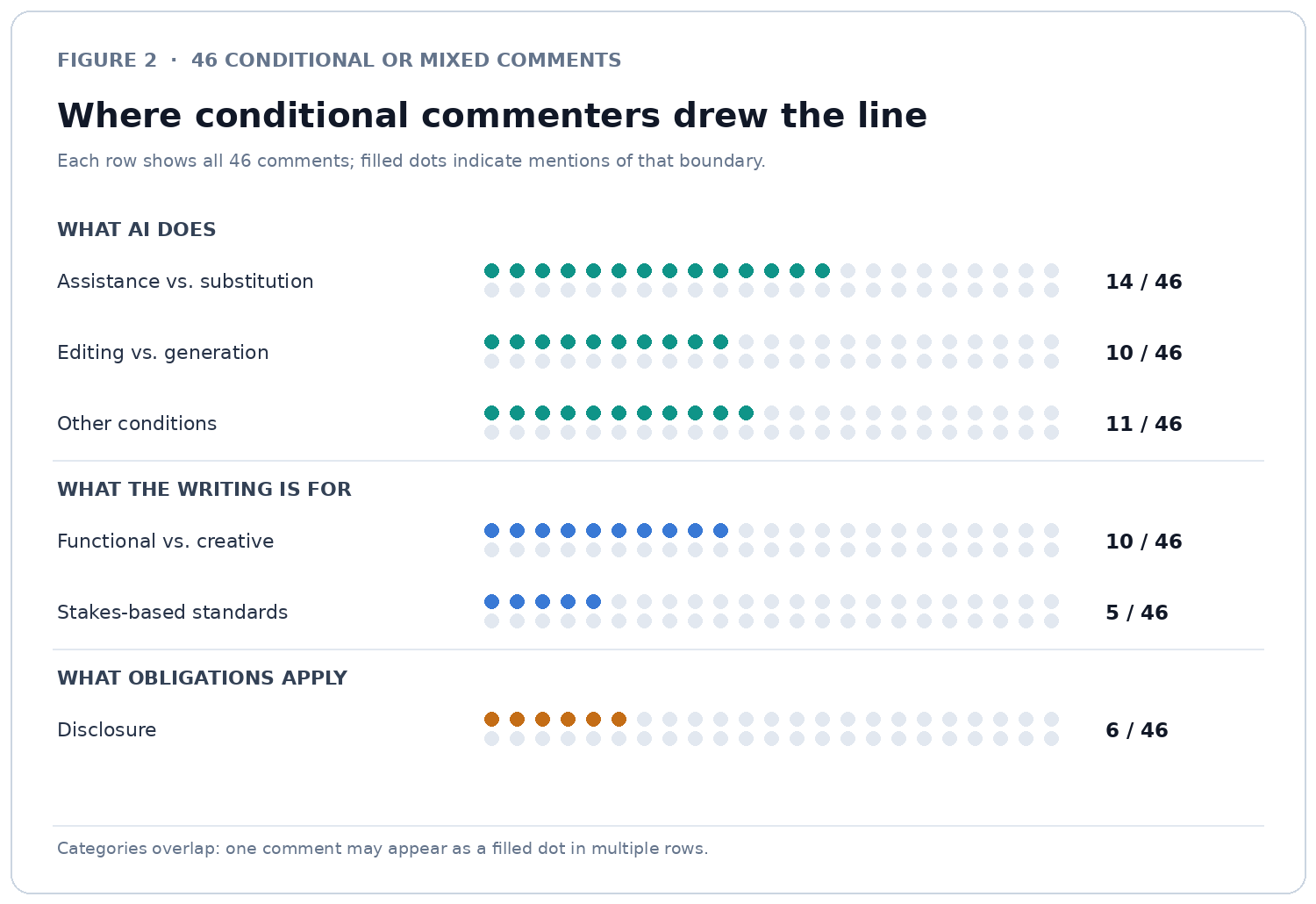
Accepting AI assistance doesn’t necessarily mean accepting it everywhere, but the boundaries people draw aren’t always where you’d expect. For some, the distinction was between editing and generating text. For others, it was between assistance and substitution, or between writing intended to accomplish a task and writing valued for the act of creating it.
Among the 46 comments expressing conditional or mixed views, assistance versus substitution was the most frequently identified boundary.
What Writers Want to Keep for Themselves
One of my favorite comments captured the distinction particularly well:
“I’m not asking AI to write my poetry, I’m asking it to help me get my work done faster so I can write poetry.”
The commenter was talking about using AI to help with technical press releases. They weren’t rejecting AI for creative work generally. They were describing what they wanted to spend their own time doing.
Other commenters drew boundaries around different parts of the process:
- Writing as thinking: One described writing as “a part of how I think,” making the process itself valuable.
- Drafting before assistance: Another preferred to write their own drafts before using AI to check consistency and explore alternative perspectives.
- Collaboration and authorship: Some compared AI assistance with ghostwriting, questioning why books or scripts created with substantial human contributions are judged differently. Others described using AI for dialogue, story development, or editing while retaining control over the underlying ideas.
These perspectives don’t establish that AI assistance and human collaboration are equivalent. But they reveal something more interesting than a simple division between acceptable and unacceptable use: people disagree about which parts of writing constitute authorship in the first place.
The Boundaries Aren't Always Clear
Even these distinctions become less clear when you look at how the work actually gets done:
- Editing vs. generation: A substantial rewrite can alter an argument more than a generated outline.
- Assistance vs. substitution: Correcting grammar isn’t the same as developing an argument or documenting a technical implementation.
- Functional vs. creative: Someone might delegate routine communications while keeping complete control over personal or creative work.
The common thread is what the writer considers essential to their contribution, and what they’re willing to delegate. Simply asking whether AI touched the text misses that distinction.
When Looking Human Becomes Part of the Job
Perhaps the strangest development in a debate about authentic writing is that some writers are deliberately making their work worse to appear more authentic. Not because the mistakes improve anything, but because writing that’s too polished can invite suspicion.
Changing the Writing to Avoid Suspicion
Several commenters described deliberately introducing or preserving errors, including a writer who said they’d canceled Grammarly and begun leaving mistakes in their work, and a novelist who discovered a typo in an already-published book and decided not to correct it after reading the article.
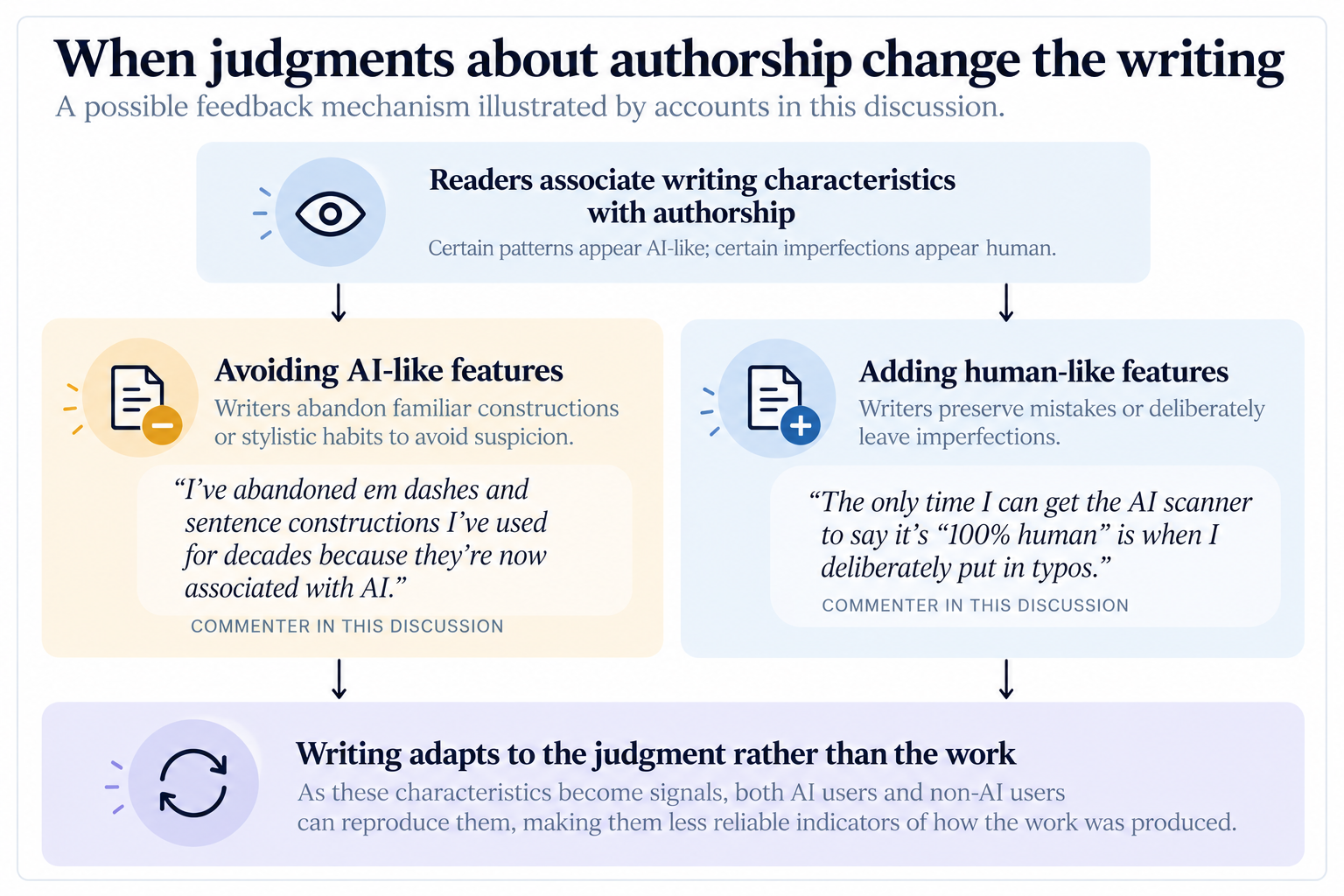
Another commenter described having abandoned em dashes and familiar sentence constructions they’d used for decades because those features were now associated with AI. Others said they were avoiding particular writing patterns, even when those patterns were part of their established style.
Not everyone was willing to participate. Several writers explicitly refused to give up em dashes, introduce mistakes, or otherwise alter their work to satisfy assumptions about what human writing should look like. One argued that writing was difficult enough without adding another layer of gamesmanship.
The accounts reveal several different responses to the same pressure:
- Adding or preserving imperfections to make writing appear more human.
- Avoiding stylistic patterns that have become associated with AI-generated prose.
- Refusing to adapt even when established writing habits invite suspicion.
- Questioning the premise, particularly when the same imperfections can easily be generated by AI.
These responses aren’t evidence that all writers are changing their behavior. But they do show that assumptions about authorship can influence how some people write, edit, and present their work.
When the Signal Becomes the Goal
There’s a problem with using writing quirks as evidence of authorship: once people know which characteristics are considered human, they can deliberately reproduce them.
Consider what happens when a typo becomes a sign of authenticity. A writer who would ordinarily correct it might leave it in place to avoid suspicion. Someone using AI could just as easily instruct it to introduce a few mistakes.
The feedback loop is straightforward:
- Certain characteristics become associated with human writing.
- People begin judging work by those characteristics.
- Writers adapt their behavior to satisfy those expectations.
- The characteristics become less useful for distinguishing how the work was produced.
Human-signaling quirks appeared in 16.1% of the comments. That doesn’t mean 16.1% of writers were deliberately introducing mistakes; the category also includes people discussing or questioning those supposed markers.
The more interesting finding is that some writers were changing their work in response to how they expected it to be judged.
The Same Problem, in Reverse
There’s an odd symmetry with something I explored in What Does the Work Prove?
AI learned stylistic patterns from human writing. Those patterns became associated with AI-generated prose, prompting some human writers to avoid them.
Now, some writers are deliberately preserving or introducing characteristics they believe will make their work look human. In both directions, expectations about authorship are influencing the writing itself.
Final Takeaway and Future Direction
The comments don’t tell us how schools, employers, or publishers are handling these questions. But they do raise practical considerations for places where writing is used for different purposes and judged against different expectations.
What Are We Actually Evaluating?
- Education: If an assignment is supposed to demonstrate that a student can develop an argument, a polished submission doesn’t necessarily establish that they can. But evaluating the work based on whether it sounds AI-generated creates a different problem. A student could do the work independently and still be suspected of cheating.
- Professional work: I’d be less concerned about whether someone used AI to help prepare a technical document than whether they understood what they were documenting. Can they explain the implementation, recognize an incorrect assumption, or update the material when the system changes? A document can look perfectly complete without answering any of those questions.
- Hiring and performance evaluation: Writing samples are often used to assess communication skills, judgment, and expertise. AI assistance makes it harder to know which capabilities a finished sample demonstrates. Yet prohibiting AI or treating familiar stylistic patterns as suspicious doesn’t necessarily provide better evidence. It may simply change how candidates prepare their submissions.
- Publishing and creative work: For some readers and writers, the author’s creative contribution is part of the value of the work. For others, the finished result matters more than the process. Those differences are harder to resolve with a blanket rule about acceptable AI use.
The practical question I’d take from all this is whether the way we evaluate writing actually rewards what we care about in that particular setting. If the goal is clear communication, does the evaluation reward clarity? If it’s independent reasoning, does it establish that reasoning took place? If it’s technical accuracy, does anyone check whether the person responsible understands the material? Or are we rewarding whatever happens to look convincing?
The accounts of writers deliberately introducing or preserving mistakes offer a small but useful warning. When a particular signal becomes the thing people are judged on, they can start optimizing for the signal instead of the quality it was supposed to represent.
And if we’re not careful about what we’re measuring, we may end up encouraging exactly the wrong behavior.