Human-in-the-Loop Is Not a Strategy
Organizations believe human presence equals oversight. It often doesn't.
Definition
Organizations often treat "human-in-the-loop" as though assigning a person automatically creates oversight. It doesn't. Oversight is a capacity, not a role. A human can remain in the workflow long after the organization's ability to meaningfully review what passes through it has been exceeded.
This framework doesn't argue that human review is worthless. It argues that naming a human as the safeguard doesn't create the safeguard. Something has to actually keep pace with what's being produced, and presence alone doesn't do that.
Mechanism
Review works when a reviewer can do three things: notice what's ambiguous, evaluate it against real judgment, and do this fast enough to keep up with what's arriving. AI changes the relationship between production and verification: production scales far faster than independent judgment.
Review capacity includes both the time available to review and the expertise required to independently evaluate what's being reviewed. A team can exhaust either one, and both failure modes end the same way: review happens without verification actually occurring.
Ambiguity scales faster than validation capacity. AI can produce plausible-looking output far faster than a person can independently verify it, so the queue of things that technically passed through "a human" grows faster than the attention available to actually interrogate any one of them.
Reviewers inherit the assumptions embedded in what they're reviewing. A person checking AI-generated work is anchored by the frame the output already presents — it's easier to check whether an answer is internally consistent than to independently rederive whether it's right. The review becomes a coherence check wearing the clothes of a correctness check.
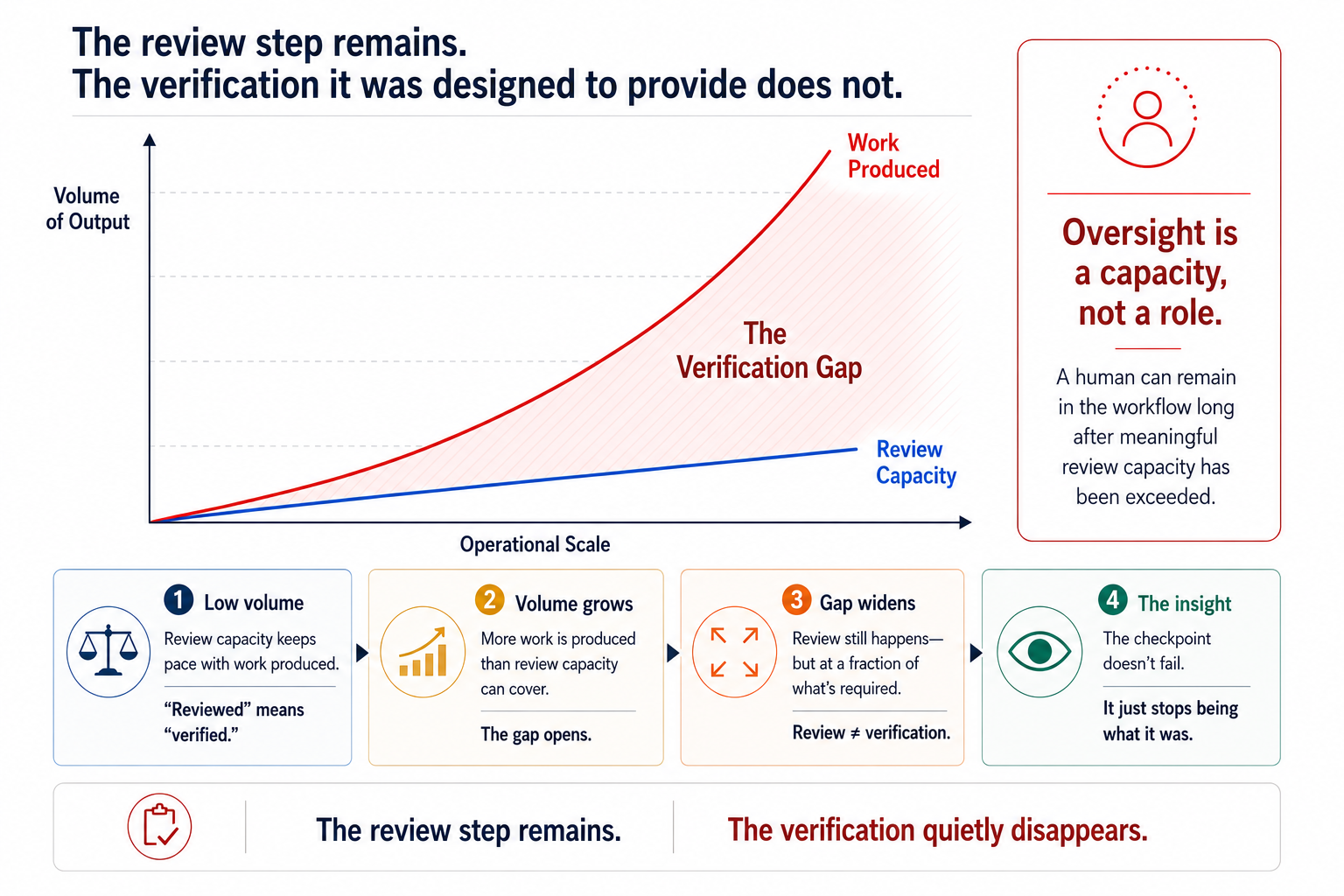
Once the gap between review capacity and review demand is wide enough for long enough, the review step doesn't disappear — it hollows out. Approvals still happen. Sign-offs still get logged. The organizational box that says "human reviewed" gets checked. What used to happen inside that box quietly stops.
The constraint underneath all of this isn't really about humans. It's about whether the reviewing system — human, automated, or some mix of both — has enough capacity to perform the function it's assumed to perform. The human is just where that constraint is most visible today.
Observable indicators
- Review turnaround time drops even as the volume or complexity of what's being reviewed increases
- Approvals cluster with unusually little variance — most things pass, few get sent back, regardless of actual quality
- Reviewers describe their own process as "sanity checking" rather than verifying
- Escalation paths exist on paper but are rarely used in practice
- The organization can name who is accountable for review, but not what specifically that person checks for
Applications
Engineering code review
A reviewer approves an AI-assisted pull request because it reads clean and matches conventions, without independently tracing whether the logic actually handles the edge cases it claims to. The review happened. The verification didn't.
Content and communications approval
A manager signs off on AI-drafted external communications because the tone and structure look right. Whether the underlying claims are accurate becomes a separate question nobody in the approval chain actually owned.
Automated decision systems with a human checkpoint
A system flags edge cases for human review before acting. As volume grows, the human checkpoint gradually becomes a rubber stamp — not because reviewers stopped caring, but because the checkpoint was never designed to absorb the volume it eventually received.
What this framework is not
This is not a claim that human oversight is inherently theatrical or that organizations are lying about their governance. Some organizations rationally accept degraded validation as an economic tradeoff — the cost of building real review capacity exceeds what they're willing to spend relative to the risk, and that can be a deliberate, defensible decision rather than a failure to notice anything.
The distinction that matters: a chosen tradeoff is different from an assumed safeguard. This framework is about the second case — organizations that believe review capacity exists because a human is present, without having checked whether that capacity actually scaled with demand.
Related frameworks
Premature Operational Confidence
Premature Operational Confidence establishes the pressure this framework describes the organizational response to: individuals and teams stop representing verification as pending. Human-in-the-Loop Is Not a Strategy picks up at the point where an organization tries to counteract that pressure by naming a human checkpoint — and shows why that response, by itself, doesn't hold.
Verification Is Becoming Infrastructure
Where this framework diagnoses why a nominal human checkpoint fails at scale, Verification Is Becoming Infrastructure describes the organizational response once that limitation is recognized: building systems that support verification instead of assuming a person's presence is sufficient.
Practical use
When a process depends on "a human will catch it," it's worth asking:
- What specifically is this person checking for, and could they describe it without reference to "does this look right"?
- Has review volume grown, and if so, has review capacity grown with it — or just the number of things labeled reviewed?
- If review turnaround has gotten faster, is that because review got more efficient, or because less is actually happening inside it?
- Is degraded validation here a decision anyone made, or an assumption nobody checked?
These questions don't determine whether a given process is currently failing. They surface whether "human-in-the-loop" is doing the work it's assumed to be doing, or just occupying the place where that work used to happen.
Human-in-the-Loop Is Not a Strategy isn't a claim that people are bad reviewers. It's a claim about what a checkpoint actually requires to keep functioning: review capacity has to scale with what's moving through it, or the checkpoint keeps its shape while quietly losing its function. Naming a human is not the same thing as building that capacity.