Premature Operational Confidence
Verification changes state without verification occurring.
Definition
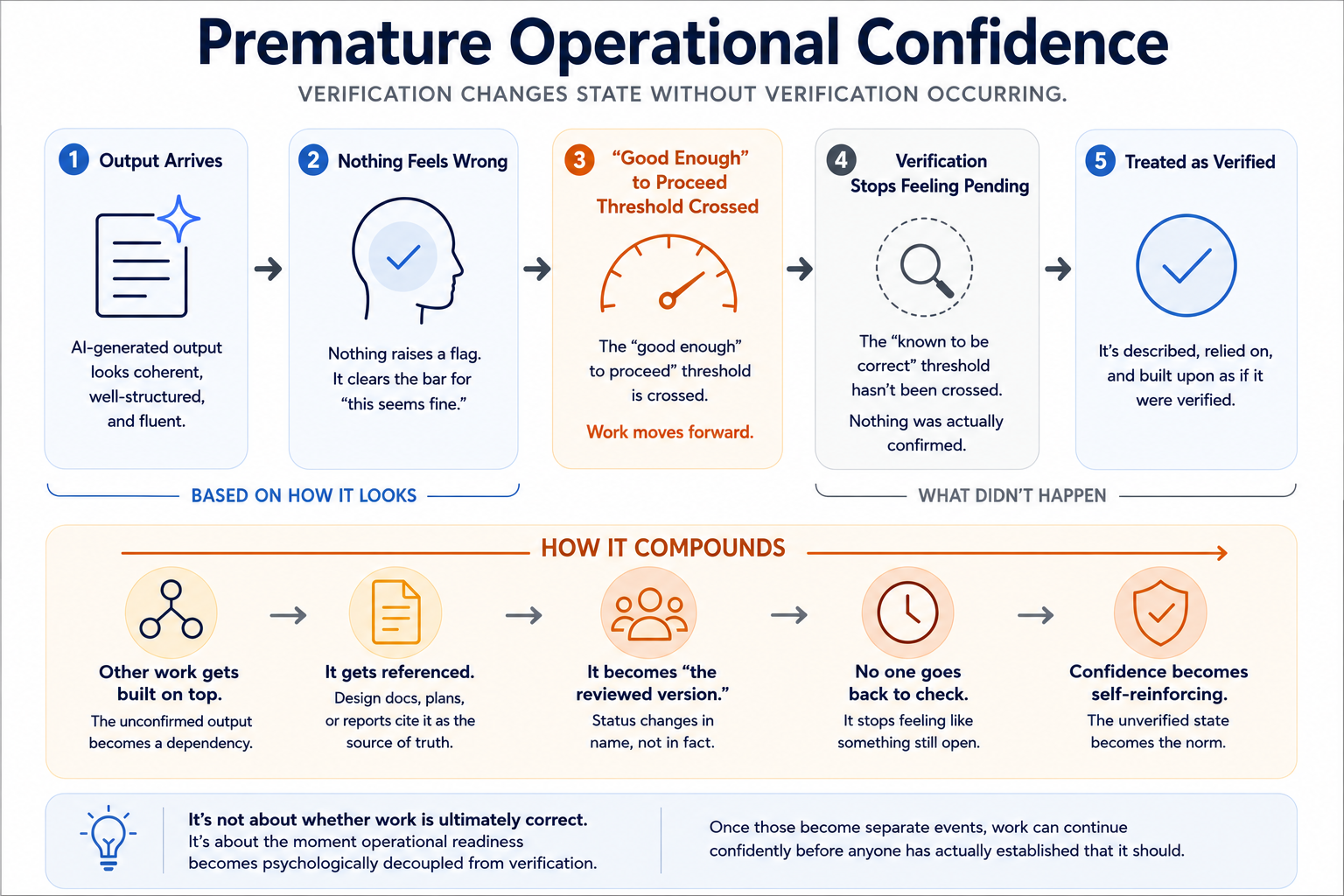
Premature Operational Confidence describes what happens when the threshold for "good enough to proceed" is crossed before the threshold for "known to be correct."
This isn't a story about carelessness. The people it happens to are usually careful — they've done the work before, they know what a problem looks like. That's exactly what makes the moment easy to miss: the point where "I'd notice if this were wrong" quietly takes over the job that "I looked for whether this is wrong" used to do.
The two thresholds used to sit close together, because confirming something was correct took real effort — effort that also happened to make it feel ready. When a signal can make work feel ready without that effort, the pairing breaks. Being ready to continue and being verified stop being the same event.
Mechanism
Work moves forward not because anyone confirmed it was ready, but because it stopped feeling unready. AI-generated output can be coherent, well-structured, and fluent enough that it clears the bar for "this seems fine" almost immediately. That bar was never the same thing as "this has been checked" — it just used to take roughly the same amount of effort to reach, so the two got treated as one event.
AI separates them. The "good enough to proceed" threshold can now be crossed in seconds, on the strength of how the output looks, while the "known to be correct" threshold hasn't been touched at all. Nobody decides to skip verification. Verification can simply stop being represented as something still pending — the distinction between looking done and being done can stop registering as a distinction.
A related but separate version of this happens at team scale: when several people independently find the same output plausible, that convergence can start functioning as though it were verification, even though no one has actually re-derived whether the output holds. Shared plausibility is not the same thing as independent confirmation, but it can feel identical from inside the group.
Observable indicators
- Finished-state language ("this works," "this is done") replaces provisional language before any actual confirmation has happened
- A specific check that would normally precede the next step gets quietly skipped — not decided against, just not run
- Caveats drop out of how someone describes their own work, even though nothing about the work itself has changed
- The next task starts before the current one is confirmed — the tell is timing, not what anyone says
- Asked directly, "what's still pending here?", the honest answer is "nothing" — not because it's true, but because pending stopped feeling like the right word
Applications
Individual work
A person reviewing AI-assisted code, writing, or analysis stops reading line by line once the output reads clean, and describes it to others as finished before anything has actually been independently checked. The output may well be fine. The pattern is the same either way.
Small teams
Several people each glance at the same AI-generated artifact, each finds it plausible, and the group treats that convergence as though it were review — without anyone having actually re-derived the result independently. The felt confidence of the group outruns any confirmation the group has actually done.
What this framework is not
This is not negligence. Negligence is knowing a check is still outstanding and choosing to skip it anyway — verification stays represented as pending, and the decision to bypass it is conscious. Premature Operational Confidence is the absence of that representation altogether: the person genuinely did not experience verification as still open.
It is also not the same thing as organizational momentum — incentive structures that reward speed and confident output over correctness at scale, budgets and governance built around an assumption before it's been established. That's a different mechanism operating at a different level, and it's easy to blur the two because they often travel together. This framework stays at the level of a person or small team; the organizational-scale version is its own subject.
Related frameworks
Coherence vs Correctness
Coherence vs Correctness establishes the gap this framework depends on: fluency and structure get mistaken for a guarantee of quality. Premature Operational Confidence describes what happens once someone starts acting inside that gap.
Plausibility Anchor
Working hypothesis, not yet confirmed: Plausibility Anchor explains why evaluation stops early — a plausible-looking output satisfies the evaluative impulse before anything has actually been verified. This framework picks up from there, describing why work then proceeds as though that early stop were a completed check.
AI Rewards Confidence Before Correctness
The organizational-scale counterpart. That framework covers what happens when this same underlying pressure gets built into incentive structures, reporting dynamics, and institutional behavior — governance, budgets, and staffing moving as though a capability has been established. Different level of analysis, different framework.
Practical use
When work is moving forward faster than expected, or a caveat that used to be there has quietly disappeared, it's worth asking:
- If I stopped right now and asked "what's still pending here?" — would the honest answer be "nothing," and if so, is that actually true?
- Did I decide this was checked, or did it just stop feeling unchecked?
- Is everyone's confidence here coming from independently confirming this, or from each of us separately finding the same thing plausible?
- What would I have done differently if I'd had to prove this was correct, rather than just noticing nothing looked wrong?
These questions don't settle whether verification actually happened. They help surface whether it was ever represented as still open in the first place.
Premature Operational Confidence isn't about whether work is ultimately correct. It's about the moment operational readiness becomes psychologically decoupled from verification. Once those become separate events, work can continue confidently before anyone has actually established that it should.