Plausibility Anchor
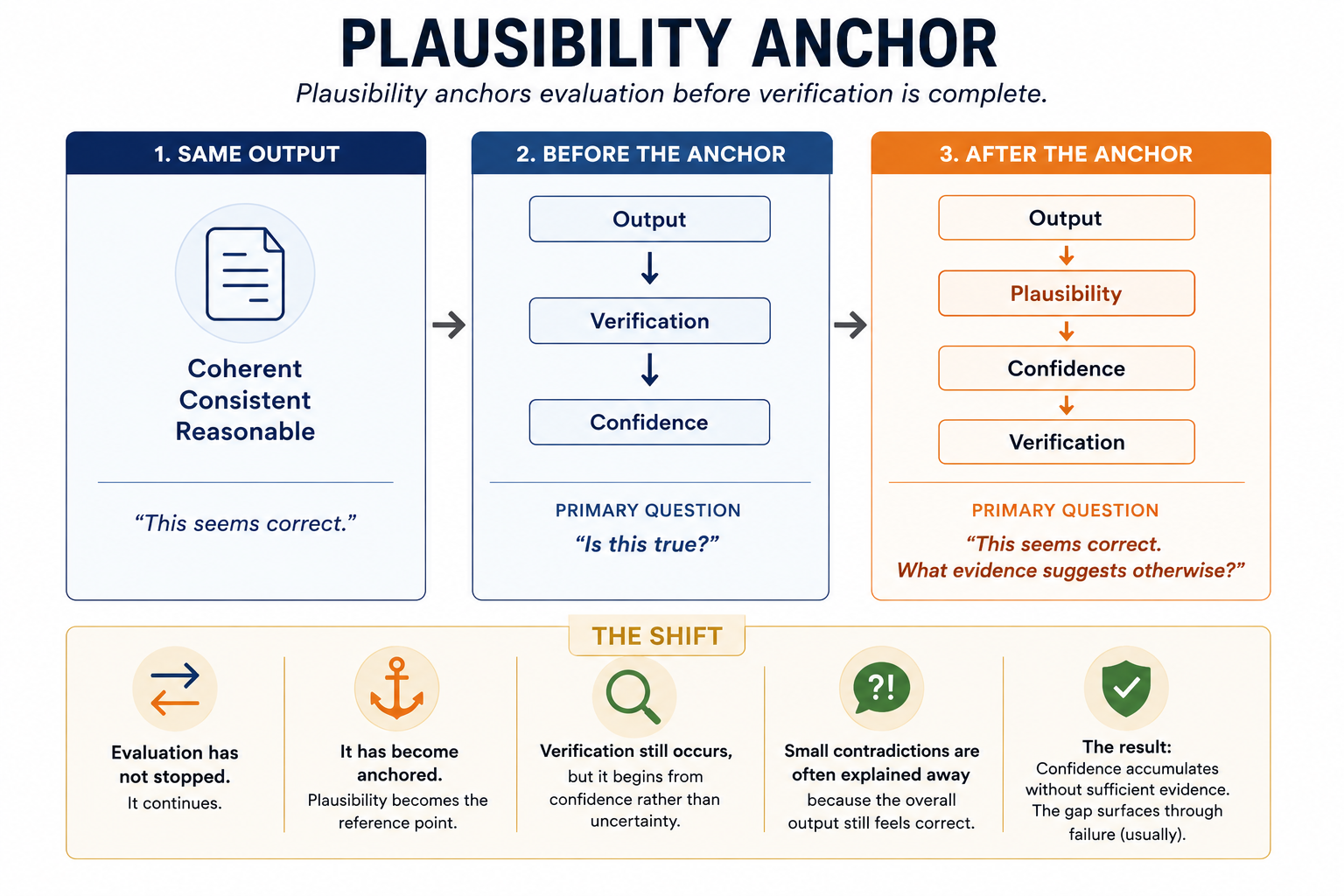
Plausibility anchors evaluation before verification is complete.
Definition
Plausibility Anchor is the tendency for evaluation to become anchored to an output's apparent coherence, consistency, or reasonableness before sufficient verification has occurred.
The problem is not that evaluation stops. The problem is that subsequent evaluation begins from the assumption that the output is probably correct. Instead of asking Is this true? evaluators increasingly begin from This appears reasonable — what evidence suggests otherwise? The verification process remains active, but its starting point has shifted.
Once plausibility is established, verification often becomes narrower, delayed, or less rigorous than the situation requires.
Mechanism
Human evaluators rarely begin from a position of complete uncertainty. Instead, they use plausibility as an initial signal — and historically, this was often adaptive. Producing coherent, well-structured work generally required expertise, effort, and domain knowledge. Plausibility functioned as a useful proxy for quality.
AI changes this relationship. Systems can now generate highly coherent outputs at low cost, making plausibility increasingly available independent of correctness. The result is that evaluation becomes anchored before verification is complete.
Plausibility Anchor becomes most influential when correctness cannot be immediately observed and verification depends on expertise, context, or investigation — exactly the conditions most common in AI-assisted knowledge work.
Observable indicators
- Reviews focused on finding minor issues rather than validating core claims
- Experts consulted after confidence has already formed, not before
- Internally consistent outputs receiving reduced scrutiny
- Small contradictions explained away because the overall output still feels correct
- Pilot success treated as evidence of production readiness
- Requests for verification declining once outputs appear reasonable
- Realizing you've been debugging the reasoning rather than questioning whether the reasoning applied to your actual problem
- Organizations discussing implementation before validation is complete
Applications
AI-generated analysis
An analysis appears thoughtful, balanced, and internally consistent. Review effort shifts toward refinement rather than verification of underlying claims.
Documentation review
A document survives review because nothing appears obviously wrong — despite limited validation of the assumptions the document depends on.
Organizational decision-making
A successful pilot becomes the anchor for broader confidence, even when critical production conditions remain untested.
AI adoption
Teams move from demonstration to implementation because the system appears capable — not because capability has been sufficiently verified under real operating conditions.
What this framework is not
Plausibility Anchor is not the same as trust. Trust can be earned through accumulated evidence. Plausibility Anchor occurs when confidence begins accumulating before that evidence exists.
It is also not a claim that plausibility is useless as a signal. In many contexts, plausibility remains a reasonable starting point. The failure mode is specific: when verification is most important — when outputs are novel, consequential, or operating under untested conditions — plausibility is least reliable as a proxy for correctness, and yet the anchor holds.
Related frameworks
Coherence vs Correctness
Coherence vs Correctness describes why coherent outputs become less reliable indicators of correctness, expertise, and validity as AI reduces the cost of producing them. Plausibility Anchor describes what happens next: evaluation anchors to the plausible signal before verification is complete. CvC is the upstream condition; Plausibility Anchor is the downstream consequence.
Trust-Verification Decoupling
Trust-Verification Decoupling describes the upstream condition: usability improvements remove the signals that would have triggered verification in the first place. Plausibility Anchor describes what happens during evaluation once verification does begin — the anchor forms before it finishes. The two frameworks describe adjacent failure modes — one in whether verification starts at all, one in how it proceeds once started.
Expertise Relocation
Plausibility Anchor helps explain why expert evaluation becomes more important as AI output scales — domain expertise is often the only reliable mechanism for detecting gaps between plausibility and correctness.
Machine-Consumed Infrastructure
Machine-consumed documentation fails partly because retrieval systems anchor on locally plausible fragments without verifying whether those fragments remain valid outside their original context. Plausibility Anchor names the evaluation behavior that makes this failure mode hard to detect.
Practical use
When evaluating outputs, decisions, pilots, or recommendations, ask:
- What evidence produced our confidence — or did plausibility do most of the work?
- Have we verified the claim, or only assessed its reasonableness?
- What would we investigate if this output had initially appeared implausible?
- Are experts reviewing before or after confidence has already formed?
- What verification steps have been skipped because the result appears reasonable?
These questions help distinguish justified confidence from confidence anchored primarily to plausibility.
The problem is not that evaluation disappears. The problem is that it continues from the wrong starting point — and by the time the gap between plausibility and reality surfaces, confidence has already accumulated around the wrong answer.