Expertise Relocation
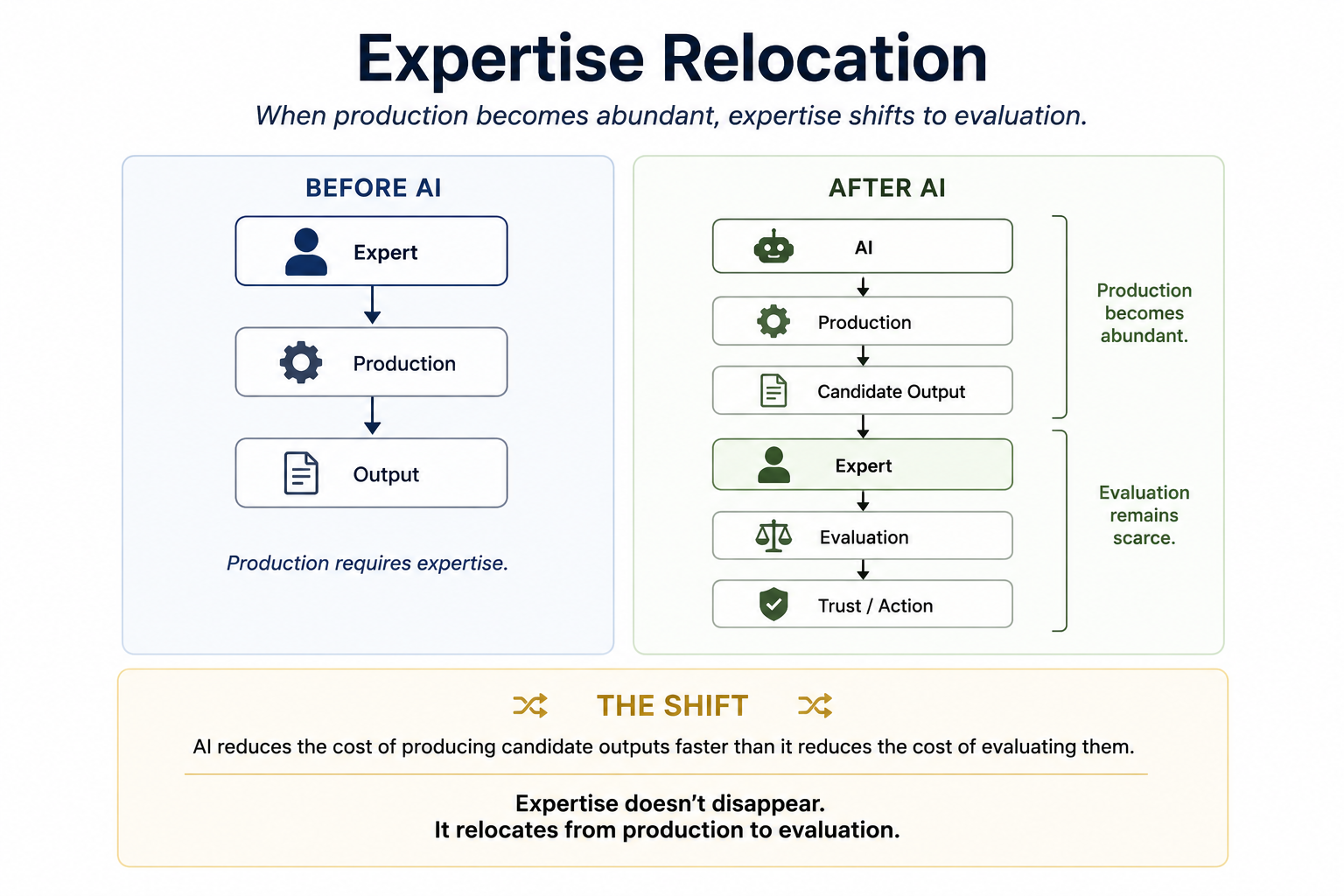
When production costs drop, expertise doesn't disappear — it relocates from production to evaluation. Organizations that measure expertise through production miss this shift entirely.
Definition
When production costs drop, expertise doesn't disappear — it relocates from production to evaluation. The expert who previously did the work is now the person who determines whether the work is acceptable. This relocation is often invisible to organizational structures that measure and reward production rather than evaluation.
Mechanism
AI reduces the cost of producing candidate outputs faster than it reduces the cost of evaluating them. When production gets cheaper, the scarce resource shifts. Expertise — the capacity to evaluate whether outputs are good — becomes the binding constraint. The expert didn't become less necessary. The work they're needed for moved.
Observable indicators
- Domain experts pulled increasingly into review loops
- Junior-heavy teams experiencing quality problems despite high output volume
- "Anyone can use AI" producing worse results than expected
- Evaluation becoming the bottleneck in previously smooth workflows
Applications
AI code generation
Senior engineers shift from writing code to reviewing AI-generated code. The production cost drops; the evaluation cost doesn't.
Documentation
Writers shift from drafting to evaluating AI drafts for accuracy, assumption validity, and fitness for audience.
Organizational design
The roles that gain value aren't the ones that produce — they're the ones that can determine whether production was successful.
What this framework is not
Expertise Relocation is not a claim that AI makes experts unnecessary. The opposite is true — expertise becomes more necessary, not less. The framework describes where that necessity shows up, not whether it exists.
It is also not a productivity argument. Output volume increasing while expert availability decreases is not a sign that things are working. It is a sign that the measurement system is looking at the wrong thing. Production is visible. Evaluation is not. Organizations that optimize for what they can see will systematically underinvest in the layer that determines whether what they produced is any good.
Related frameworks
Machine-Consumed Infrastructure
Both frameworks describe expertise becoming more critical as AI enters a workflow. Machine-Consumed Infrastructure focuses on what happens to information systems when the consumer changes. Expertise Relocation focuses on what happens to the people responsible for evaluating those systems.
Plausibility Anchor
Plausibility Anchor helps explain why expert evaluation becomes harder to replace as AI output scales. When plausibility anchors evaluation prematurely, domain expertise becomes the primary mechanism for detecting gaps between what looks correct and what actually is.
Organizations that measure expertise through production will systematically overload the people who have become their evaluation layer. The work that determines quality becomes invisible at exactly the moment it becomes most important.