Machine-Consumed Infrastructure
The infrastructure isn't broken. It's being used by a consumer it wasn't designed for.
Definition
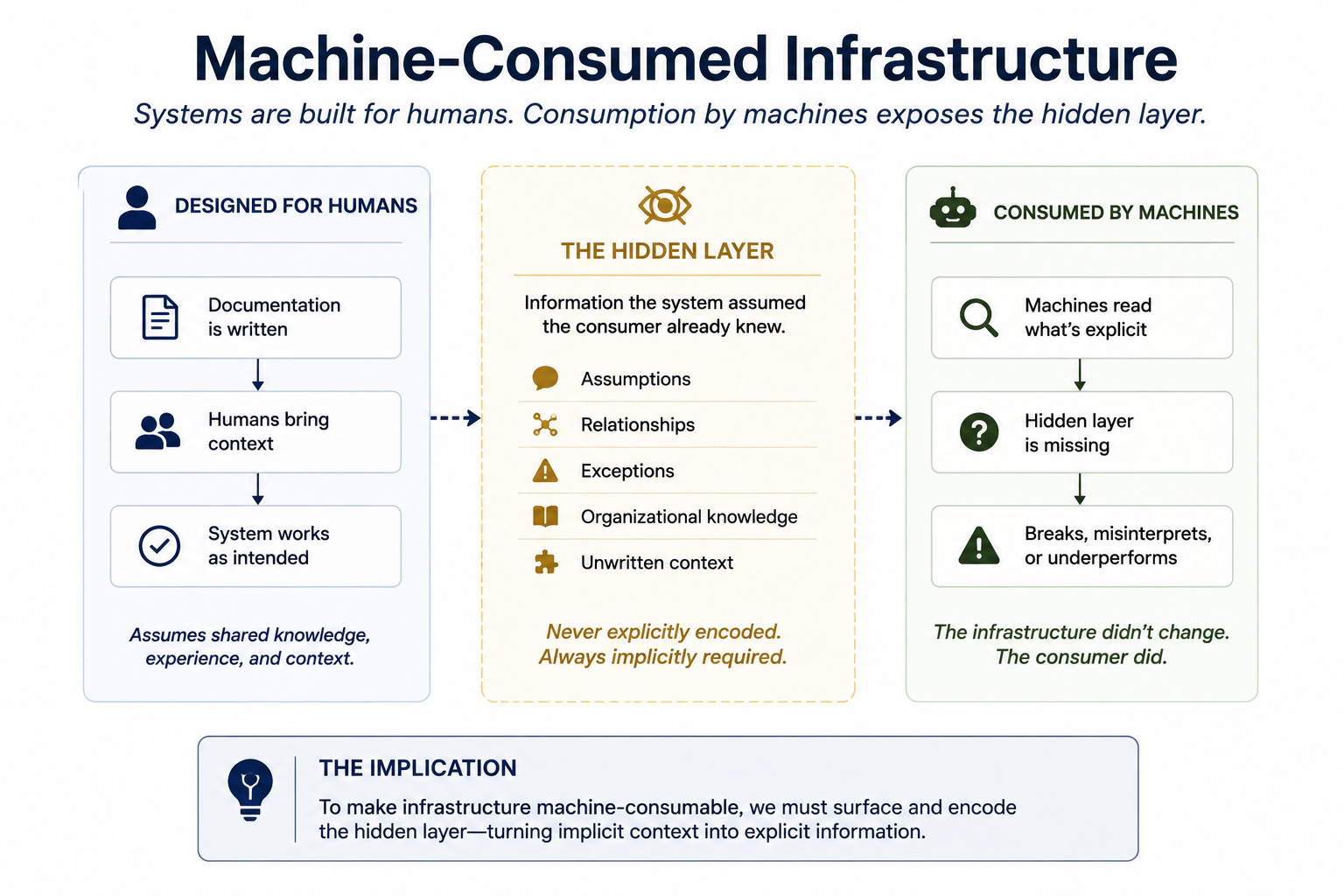
Documentation, APIs, and knowledge systems were built for humans — readers who interpret, infer, and exercise judgment about what applies to their situation. When AI agents become primary consumers of that infrastructure, they consume it differently: literally, without inference, without the ambient context human readers supply. The assumptions embedded in the infrastructure surface as failures. The infrastructure isn't broken. It's being used by a consumer it wasn't designed for.
Mechanism
Information systems get designed with a specific consumer in mind — usually a human reader who brings context, infers meaning, and exercises judgment about what applies. When the actual consumer changes, the assumptions embedded in that design become failure points. AI agents consume documentation literally, without the interpretive tolerance human readers supply.
What was written as guidance becomes instruction. What was implicit becomes operational. What was context becomes fact.
Observable indicators
- AI systems producing confident outputs that contradict documentation the team considers authoritative
- Retrieval returning technically correct content that agents apply in wrong contexts
- Documentation that human readers find clear producing hallucinations or errors when consumed by agents
- Assumptions the team considers obvious turning out not to be written down anywhere
Applications
Internal knowledge bases
Built for employees who share organizational context. Agents retrieve fragments without the surrounding context that made those fragments meaningful.
API documentation
Written for developers who exercise judgment about edge cases. Agents encounter those edge cases without the judgment developers would have applied.
Technical documentation and runbooks
Agents follow instructions literally — including instructions practitioners would have recognized as inapplicable to the current situation.
What this framework is not
Not a documentation quality problem. Improving prose, adding detail, or increasing accuracy won't resolve failures caused by consumer substitution. The fix requires reconsidering design assumptions, not just content quality. Better retrieval returns the wrong assumptions more efficiently.
Related frameworks
Expertise Relocation
When documentation becomes machine-consumed infrastructure, the evaluation burden shifts to the people who can detect failures. Expertise Relocation describes what happens to those people — and why they become increasingly scarce at exactly the moment they're most needed.
Plausibility Anchor
Machine-consumed documentation fails partly because retrieval systems anchor on locally plausible fragments without verifying whether those fragments remain valid outside their original context. Plausibility Anchor names the evaluation behavior that makes this failure mode hard to detect.
If your documentation was designed for human readers, improving it as documentation may not solve the failures you're seeing with agents. The question isn't whether the content is accurate. It's whether the design assumptions — about what the consumer already knows, how they'll handle ambiguity, what they'll infer — still hold for the consumer actually using it.