Trust-Verification Decoupling
Usability improvements can remove uncertainty cues faster than they remove uncertainty itself.
Definition
Trust-Verification Decoupling describes the pattern in which improvements to AI usability — smoother interfaces, more coherent outputs, fewer visible errors — remove the signals that historically triggered verification behavior, before the underlying uncertainty those signals were indicating has been resolved.
The problem is not that AI systems are becoming more capable. The problem is that they are becoming easier to trust independently of whether they have become more trustworthy.
Verification that was once triggered automatically — by friction, inconsistency, or visible error — must now be triggered deliberately, by choice rather than by signal. When that deliberate behavior does not emerge, the gap between ease of trust and actual trustworthiness widens without producing a visible warning.
Mechanism
Humans have never assessed uncertainty directly. Instead, they rely on proxy signals — friction, inconsistency, visible errors, interface breakdowns — to detect when uncertainty is present and verification is required. These signals were imperfect but functional. When an AI system produced an obvious error, users checked more carefully. When outputs were inconsistent, confidence declined. The verification behavior was naturally triggered.
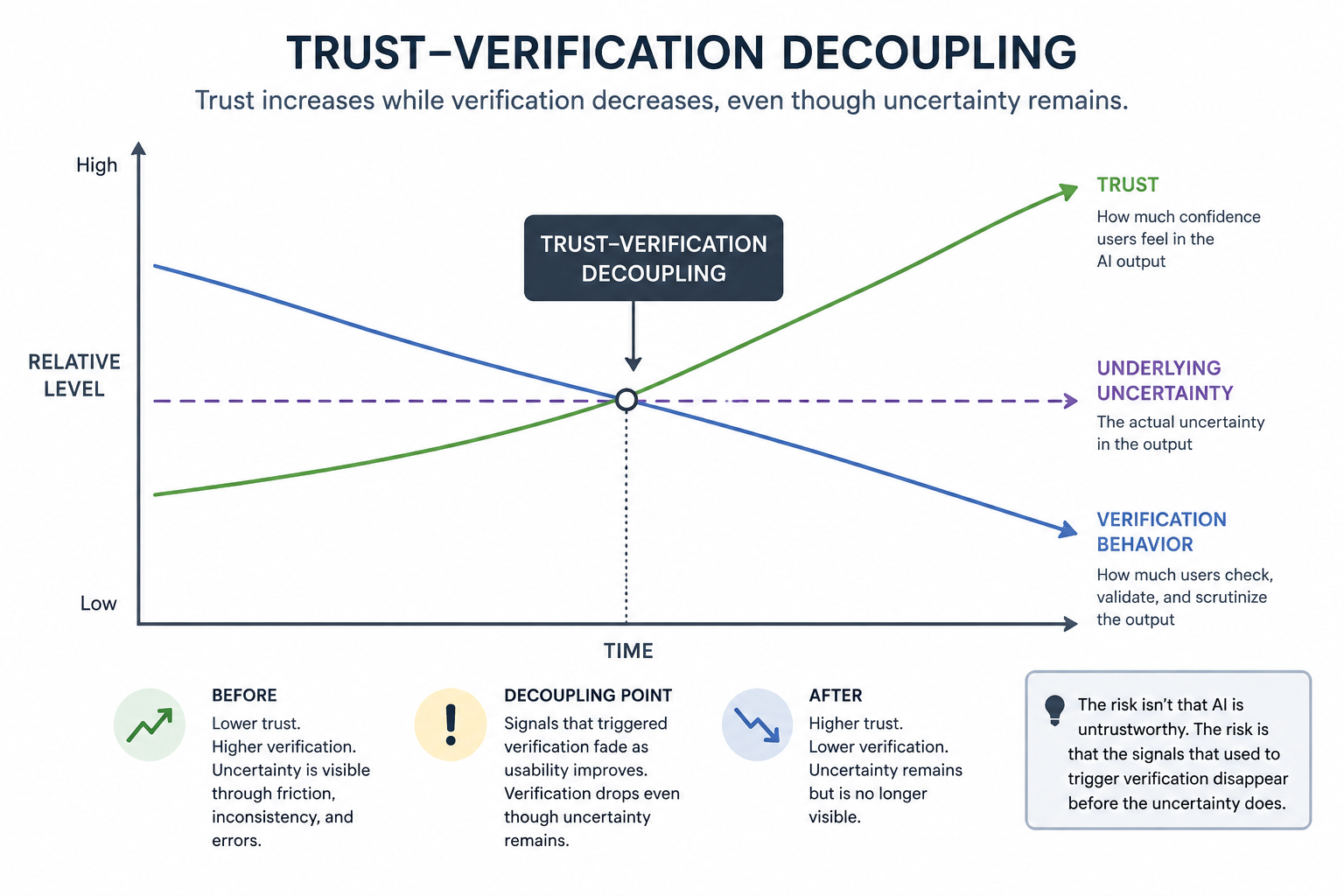
As AI systems improve, many of these signals disappear. Outputs become cleaner. Reasoning becomes more persuasive. Errors become harder to notice. The interface becomes frictionless. Each of these improvements is genuine — but collectively, they remove the conditions that triggered verification without removing the need for it.
The result is a structural inversion: AI can become easier to trust faster than it becomes trustworthy. Users calibrated to earlier, more obviously imperfect systems bring verification habits formed under different conditions. Those habits atrophy precisely as the stakes of not verifying increase.
Observable indicators
- Teams reducing review steps as AI outputs become more polished
- Verification effort inversely tracking with output quality — less checking as outputs improve
- Errors discovered downstream that earlier, rougher systems would have flagged through visible inconsistency
- Users reporting higher confidence in newer model versions without corresponding changes in verification practice
- Onboarding processes treating AI fluency as readiness without addressing verification discipline
- Organizational trust in AI systems outpacing internal capacity to detect failures
- Verification steps that were standard during early adoption quietly disappearing from process documentation
Applications
Agent-readiness scoring
An organization redesigned its documentation and information architecture for AI consumption, raising an independent agent-readiness assessment from 65% to 92%. The higher score made the implementation appear substantially more AI-ready almost immediately. Whether AI systems drawing on that documentation behaved reliably across edge cases and ambiguous situations was a slower, separate question. The score improved faster than certainty did. Verification didn't become less important. It stopped being naturally prompted by the score itself.
Model upgrades
A team transitions to a newer, more capable model. Outputs improve visibly. Review processes established for the previous model quietly attenuate, not by decision, but by drift. It produces fewer obvious errors, so fewer errors get caught.
AI-assisted writing and analysis
Early drafts from AI tools required significant editing and triggered active scrutiny. As output quality improves, editing effort decreases and scrutiny decreases with it — including scrutiny of factual claims, logical gaps, and unstated assumptions the author would previously have caught.
Agentic systems
Autonomous AI systems that operate with less visible intermediate output remove the observation points that previously triggered human review. Verification becomes difficult not because it is discouraged but because there is less to observe.
Organizational AI adoption
Adoption metrics track usage, satisfaction, and output volume. They rarely track verification discipline. As AI becomes easier to use, adoption accelerates — and the gap between organizational trust and validated reliability may widen without appearing in any dashboard.
What this framework is not
This is not a claim that AI systems should be kept difficult to use. Usability improvements are genuine improvements. The failure mode is not that friction disappears — it is that verification behavior was never decoupled from friction in the first place.
It is also not a claim that AI systems are untrustworthy. Some are highly reliable in well-defined contexts. The framework addresses the gap between how trustworthy a system feels and how trustworthy it has been demonstrated to be — a gap that usability improvements can widen without either party noticing.
Related frameworks
Plausibility Anchor
Plausibility Anchor describes how evaluation becomes anchored to apparent coherence before verification is complete. Trust-Verification Decoupling describes the upstream condition: usability improvements remove the signals that would have triggered verification in the first place. The two frameworks describe adjacent failure modes — one in how evaluation starts, one in whether it starts at all.
Coherence vs Correctness
Coherence vs Correctness establishes that fluency and correctness have become decoupled. Trust-Verification Decoupling describes a consequence of that decoupling at the behavioral level: as outputs become more fluent, verification behavior decreases — precisely when the gap between fluency and correctness makes verification most necessary.
Expertise Relocation
Expertise Relocation describes how the valuable work shifts from production to evaluation as AI reduces generation costs. Trust-Verification Decoupling describes a countervailing pressure: as outputs improve, the demand for evaluation decreases even as its importance increases. The two frameworks identify opposite forces acting on the same function.
Practical use
When adopting or expanding AI systems, ask:
- Has our verification practice changed as output quality improved — and was that change a decision or drift?
- What signals were triggering verification before, and are those signals still present?
- If this system became significantly more capable tomorrow, would our review process catch the difference between more capable and more trustworthy?
- Where in our workflow has friction disappeared, and was that friction doing verification work?
- Are we measuring AI adoption, satisfaction, and output volume — or are we also measuring verification discipline?
Status notes
Published framework. The core mechanism — usability improvements removing uncertainty cues faster than they remove uncertainty — is stable across multiple observed contexts. The transitional claim is worth holding carefully: future AI interfaces may incorporate explicit uncertainty signaling, confidence intervals, or provenance indicators that partially restore the proxy signals usability improvements removed. The durable underlying claim is about the decoupling of ease-of-trust from trustworthiness, not about any specific interface generation.
The hidden assumption is that verification happens because people are diligent. In practice, verification often happens because uncertainty is visible. When the uncertainty disappears from view, the behavior can disappear with it.