Coherence vs Correctness
When coherent outputs become cheap to produce, coherence becomes a less reliable indicator of correctness, expertise, and validity.
Definition
Coherence vs Correctness describes what happens when signals that were once used as proxies for correctness, expertise, or validity become easier to generate than the properties they were assumed to indicate.
Organizations, managers, and individuals routinely rely on indirect signals when evaluating information. Coherent reasoning often functions as evidence of understanding. Fluent communication often functions as evidence of expertise. Confident explanations often functions as evidence of correctness.
These relationships are imperfect, but they are often useful. The signal does not guarantee the underlying property, yet it provides a practical basis for evaluation.
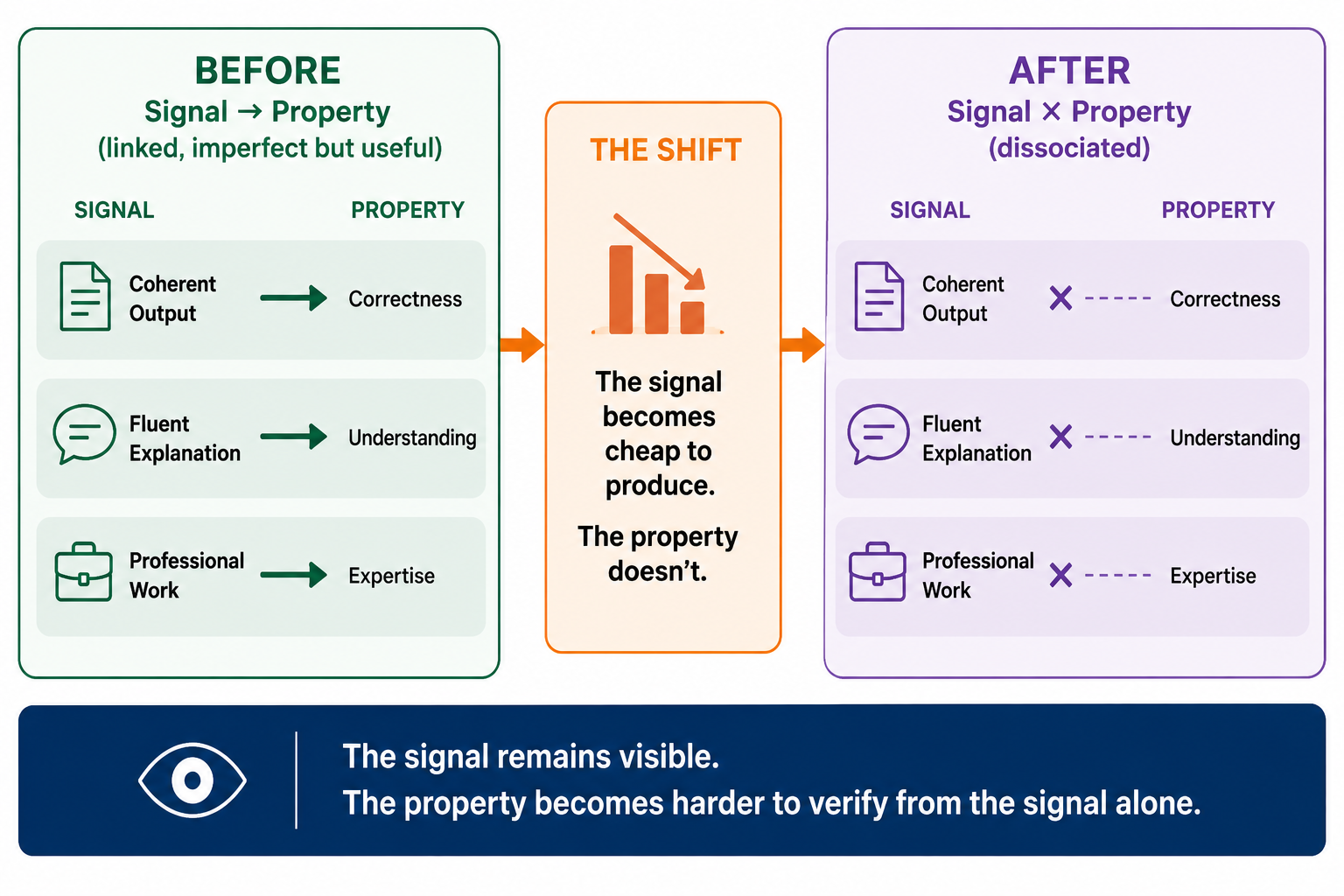
The pattern changes when the cost of producing the signal falls dramatically. When coherent outputs become cheap to produce, coherence becomes a less reliable indicator of the properties it was previously associated with. The signal remains visible. The property becomes harder to verify from the signal alone.
As a result, evaluators increasingly encounter outputs that appear to demonstrate understanding without necessarily reflecting it. Production quality becomes a weaker proxy for expertise. Fluency becomes a weaker proxy for correctness. Coherence becomes a weaker proxy for validity.
The challenge is not that coherence becomes worthless. The challenge is that the relationship between signal and property weakens while evaluation practices often remain calibrated to the older relationship.
The pattern is most visible in domains where correctness is difficult to verify directly and evaluators rely on indirect signals as practical proxies for expertise, validity, or understanding. The result is a growing gap between what can be observed and what must be verified.
Mechanism
For most of the history of knowledge work, coherence was a reasonable proxy for correctness. Producing fluent, well-structured, persuasive output required genuine understanding of the domain. The signal and the property were linked — not perfectly, but reliably enough to be useful.
When the cost of producing coherent outputs drops dramatically, that link weakens. Fluency becomes easier to generate than understanding. Coherence becomes easier to produce than correctness. The signal remains visible. The property becomes harder to verify from the signal alone.
Evaluation practices calibrated to the older relationship continue operating — because the signal still looks the same.
This framework is not specific to AI. The same pattern appears wherever the cost of producing a signal drops independently of the cost of producing the underlying property: production quality was once used as evidence of expertise; the signal became easier to generate; the signal and the property separated. AI is the most acute current context — not the definition of the mechanism.
Failure modes
Expertise detection degrades
Managers and teams lose the ability to use output quality as a proxy for underlying expertise. The person who produces coherent work and the person who understands the domain become harder to distinguish from observable outputs alone. Hiring, promotion, and task assignment signals weaken simultaneously — not because expertise disappeared, but because the signal that previously indicated it became generatable independently of the property.
Review shifts from understanding-verification to presentation-verification
Reviewers increasingly assess whether work looks right rather than whether the reasoning underneath it holds. The review step continues to function and to feel productive while becoming less effective at detecting correctness failures.
Trust calibration breaks asymmetrically
Outputs that are coherent-but-wrong receive more trust than they warrant. Outputs that are correct-but-incoherent receive less. The evaluator's prior — coherence indicates correctness — continues operating after it stops being reliable. Errors cluster in the gap between what appears trustworthy and what has actually been verified.
Signal disputes replace property disputes
Disagreements about correctness increasingly occur through disagreements about observable signals rather than the underlying properties themselves. The absence of visible incoherence begins to function as evidence, even when the underlying property has not been established.
Because the underlying properties are harder to observe directly, organizations often experience the failure as a communication, culture, or review problem rather than an evaluation problem. Interventions follow the presenting symptom — communication training, style guides, review process tweaks, better prompts — while the actual issue remains unaddressed: the observable signal is no longer carrying the information evaluators think it is.
Observable indicators
- Managers report difficulty distinguishing high-output contributors from high-understanding contributors after AI adoption
- Performance evaluations increasingly reference output volume, polish, or presentation quality rather than demonstrated reasoning or judgment
- Correct-but-rough outputs from human contributors receive more scrutiny than polished-but-flawed AI-assisted outputs
- Review feedback concentrates on surface properties — clarity, structure, tone — because those are what reviewers can reliably assess
- Disagreements about whether an output is good increasingly become debates about whether it seems good rather than whether it is good
- Post-mortem analysis of failures reveals the output "looked fine" to multiple reviewers — coherence was present, correctness was not
- Organizations responding to quality failures reach for style guides, prompt improvements, or communication training rather than verification process changes
Applications
Knowledge work and expertise assessment
When AI can produce outputs that look expert, the signals previously used to identify expertise — fluency, coherence, apparent confidence — become weaker proxies. Teams relying on output quality to identify who understands the domain will increasingly misallocate trust and responsibility.
AI-generated analysis and documentation
Analysis or documentation that is internally coherent but built on flawed assumptions passes review at higher rates than before. Reviewers validate presentation rather than underlying claims, and errors surface downstream rather than at the review stage.
Hiring and performance evaluation
Interview outputs, writing samples, and work products that are AI-assisted may appear indistinguishable from work reflecting genuine expertise. Evaluation systems calibrated to coherence as a proxy for capability require recalibration.
Organizational decision-making
Recommendations, proposals, and analyses that are coherent-but-wrong receive endorsement. The problem surfaces not when the output is presented, but when it is operationalized — and by then, confidence has already accumulated.
What this framework is not
Coherence vs Correctness is not a claim that coherent outputs should be distrusted. Coherence remains useful as an initial signal. The failure mode is specific: when verification matters most — when outputs are novel, consequential, or difficult to assess directly — coherence is least reliable as a proxy for correctness, and yet evaluation continues to treat it as if it is.
It is also not primarily a claim about AI hallucination. Hallucination produces outputs that are detectably wrong. Coherence vs Correctness describes outputs that are coherent-but-wrong in ways that are not immediately detectable — where the failure is that the signal never indicated what it appeared to indicate.
Related frameworks
Plausibility Anchor
Coherence vs Correctness describes the structural shift in the signal itself — why coherence becomes a less reliable indicator of correctness, expertise, and validity. Plausibility Anchor describes what happens to evaluation behavior after a plausible signal takes hold: evaluation anchors, verification shortens. CvC is the upstream condition; Plausibility Anchor is the downstream consequence.
Expertise Relocation
Expertise Relocation asks where expertise went when production costs dropped — from production to evaluation. Coherence vs Correctness asks why expertise became harder to recognize from observable outputs. Both describe consequences of the same underlying shift, operating at different levels.
Machine-Consumed Infrastructure
Machine-Consumed Infrastructure describes what happens when documentation designed for human readers — who infer, interpret, and exercise judgment — is consumed by systems that don't. Coherence vs Correctness names the upstream evaluation failure that makes machine-consumed documentation hard to audit: the outputs machines produce from that documentation are coherent, which makes the underlying failures difficult to detect.
Practical use
When evaluating outputs, analysis, or work products, ask:
- Am I assessing whether this is correct, or whether it seems correct?
- What would I investigate if this output had initially appeared incoherent?
- Is the person who produced this demonstrating understanding, or producing signals that previously indicated understanding?
- What verification steps have been skipped because the output appears well-reasoned?
- If this turns out to be wrong, how long before we'd detect it — and what would we be looking at when we did?
These questions help distinguish evaluation of the signal from evaluation of the property the signal was assumed to indicate.
The problem isn't that coherent outputs should be distrusted. It's that coherence alone is no longer sufficient evidence of what it used to indicate — including judgments about the work itself, and judgments about the people producing it. The question shifts from does this look right? to how would I know if it weren't? Those are different questions, and they require different evaluation practices.