The Proxy Was the System
The proxy wasn't a stand-in for the system. It was the system.
Definition
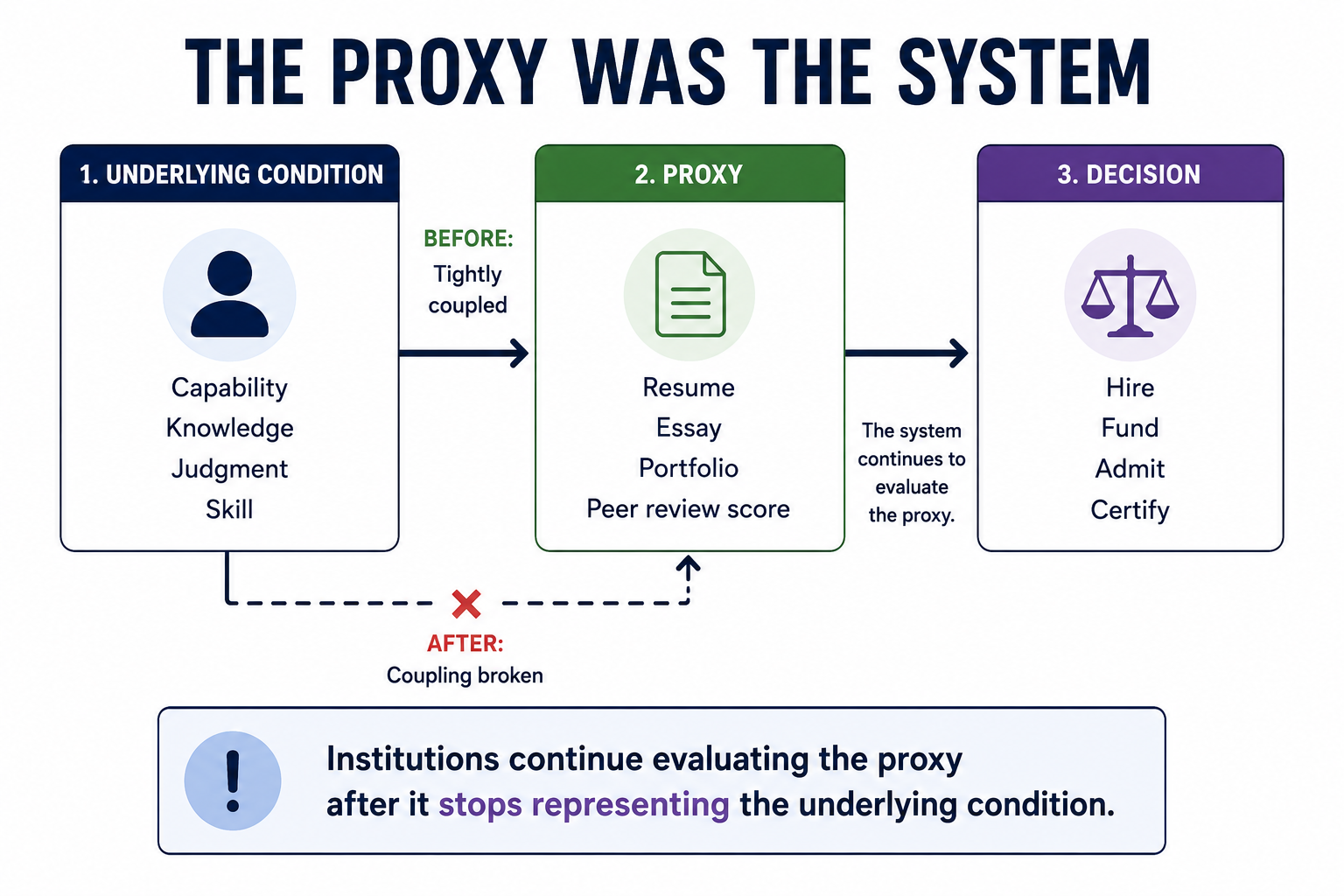
The Proxy Was the System describes what happens when an institution substitutes an observable signal for an underlying condition that is expensive or impossible to observe directly — and later discovers that the signal was never a shortcut around the system. It was how the system operated at all.
The substitution remains reliable only while producing the signal requires the underlying condition. A resume, an essay, a portfolio, a peer-review score: each one worked as a proxy because producing it well required the thing it claimed to represent. The artifact and the condition were bundled together.
The failure isn't that the proxy was flawed from the start. It's that the coupling holding proxy and condition together can break quietly, long after the system was built around assuming it wouldn't.
Mechanism
Institutions rarely have a scalable way to observe capability, quality, or intent directly. Instead, they rely on artifacts whose production used to be expensive enough that producing one well required the underlying condition — effort, expertise, judgment, time. That coupling is what made the proxy trustworthy. It wasn't measuring the condition from a distance; producing the proxy well was largely inseparable from having the condition.
AI breaks that coupling. It makes the signal cheap to produce without making the underlying condition any easier to observe. The proxy doesn't get worse — it gets separable from what it was supposed to represent. The system built around the old coupling doesn't announce the break. It keeps running the same artifact through the same process until the artifact produces an output that finally makes the break visible.
Discovery is not guaranteed. Under passive degradation, reality eventually diverges enough to force confrontation — a funding lottery, a hiring pipeline that stops differentiating candidates, a credential that stops correlating with capability. Under active gaming, where actors optimize directly against the proxy, the instrument can keep reporting healthy scores indefinitely, deferring discovery.
Observable indicators
- An evaluation process that used to differentiate candidates or proposals starts returning ties, clusters, or indistinguishable scores at the margin
- An institution keeps requiring an artifact even after acknowledging, informally or formally, that the artifact no longer reliably indicates what it once did
- Replacing the artifact is treated as a simple substitution, when in fact no scalable way to observe the underlying condition directly currently exists
- The response to degradation is more scrutiny of the artifact, when the actual problem is that the artifact stopped being coupled to the condition
- Asking "would we still use this if we could observe the real thing directly?" and getting an honest no
Applications
Hiring and education
Resumes, essays, and portfolios functioned as proxies because producing them well required real capability. AI separates the artifact from the capability, leaving institutions with a signal that no longer tracks what it once did — and no ready alternative for observing capability directly at scale.
Peer review
Research quality is inherently difficult to observe before the fact — the contribution a proposal will make is, in part, temporally unavailable at the decision point. When review scores stop differentiating proposals near a funding threshold, some funders resolve the resulting tie by lottery rather than by further ranking. The lottery is the moment the broken proxy becomes visible, not the cause of the break.
Grant funding
Confirmed under full five-criteria review. Multiple major funders — the Swiss National Science Foundation, New Zealand's Health Research Council, and others — have adopted lottery mechanisms rather than pursuing better predictive measurement, a behavioral admission that the underlying condition (future research merit) resists scalable observation, not a case of institutions simply being slow to build a fix.
Optional further depth
Academic hiring is supported by the same peer-review literature that generalizes the temporal-observability structure to grant review, but hasn't been run through independent five-criteria review — it isn't required, since gating already cleared on three confirmed domains (education/hiring, peer review, grant funding).
What this framework is not
This is not a claim that people are cheating more, or that institutions are naive. Cheating implies a system that's still basically sound under new adversarial pressure. This framework describes something else: a system that was never built to detect the underlying condition directly, and is only now discovering that its actual measurement mechanism has been quietly repossessed.
It is also not the same failure as ordinary institutional slowness. Some domains that look similar on the surface — continued use of an imperfect proxy, known limitations, no current alternative — are stuck for a different reason: better measurement is actively being developed and is a matter of time, not a structural observability constraint. That's a development lag, not this mechanism, and the two are easy to conflate.
Related frameworks
Plausibility Anchor
Tentatively distinct. Plausibility Anchor operates at the evaluation moment — it resolves once the evaluator is fully informed and stops being fooled by the signal. The Proxy Was the System persists even after everyone involved knows the proxy is degraded, because the system still has no scalable alternative. Different failure mode, different level of analysis.
Practical use
When an evaluation, credential, or measurement process starts behaving strangely — ties where there used to be differentiation, declining signal, growing reliance on gut-check overrides — ask:
- Does producing this artifact still require the underlying condition, or has that link come apart?
- If we could observe the underlying condition directly, would we still be using this artifact?
- Is our continued reliance explained by a genuine observability constraint, or by an alternative simply not being built yet?
- If this proxy stopped working entirely tomorrow, does our institution have any scalable way to observe the real thing — or was the proxy the only mechanism we had?
These questions help distinguish a system that needs a better proxy from a system that was never built to work without one.
AI didn't attack the system from outside. It repossessed the mechanism the system was quietly built on, and left behind an institution that looks exactly the same, asks for exactly the same artifacts, and has no idea it's no longer measuring anything.