In brief: As AI takes over some routine work, what happens to the experiences that help people develop expertise? Could evaluating AI output replace some of what they might lose?
AI was supposed to take the tedious work off our hands. Instead, we're complaining about how tedious it is to check whether AI did the work correctly. We've even given that job a name: botsitting.
Fair enough. Nobody wants to spend their day cleaning up after a machine that's supposed to be making their job easier. But there's something we've overlooked in our enthusiasm for automating routine work. A lot of that repetition wasn't just producing output. It was part of how people learned the job.
You don't become an expert exclusively by handling unusual cases. You develop a sense for what's normal by seeing enough of it. You make mistakes, get corrected, encounter variations, and gradually learn which details matter. The work that looks repetitive from a production perspective may be doing something quite different for the person performing it.
I've written before about how AI relocates expertise from producing outputs toward evaluating them. But that leaves another question: how do people develop the judgment the new workflow depends on? To the extent AI takes over routine work, it may also remove some of the experiences that helped people develop that judgment. Could checking AI's work teach people some of what doing the work used to? Or are we building workflows where the AI gets better from every correction while the person doing the correcting doesn't?
A review queue isn't a curriculum
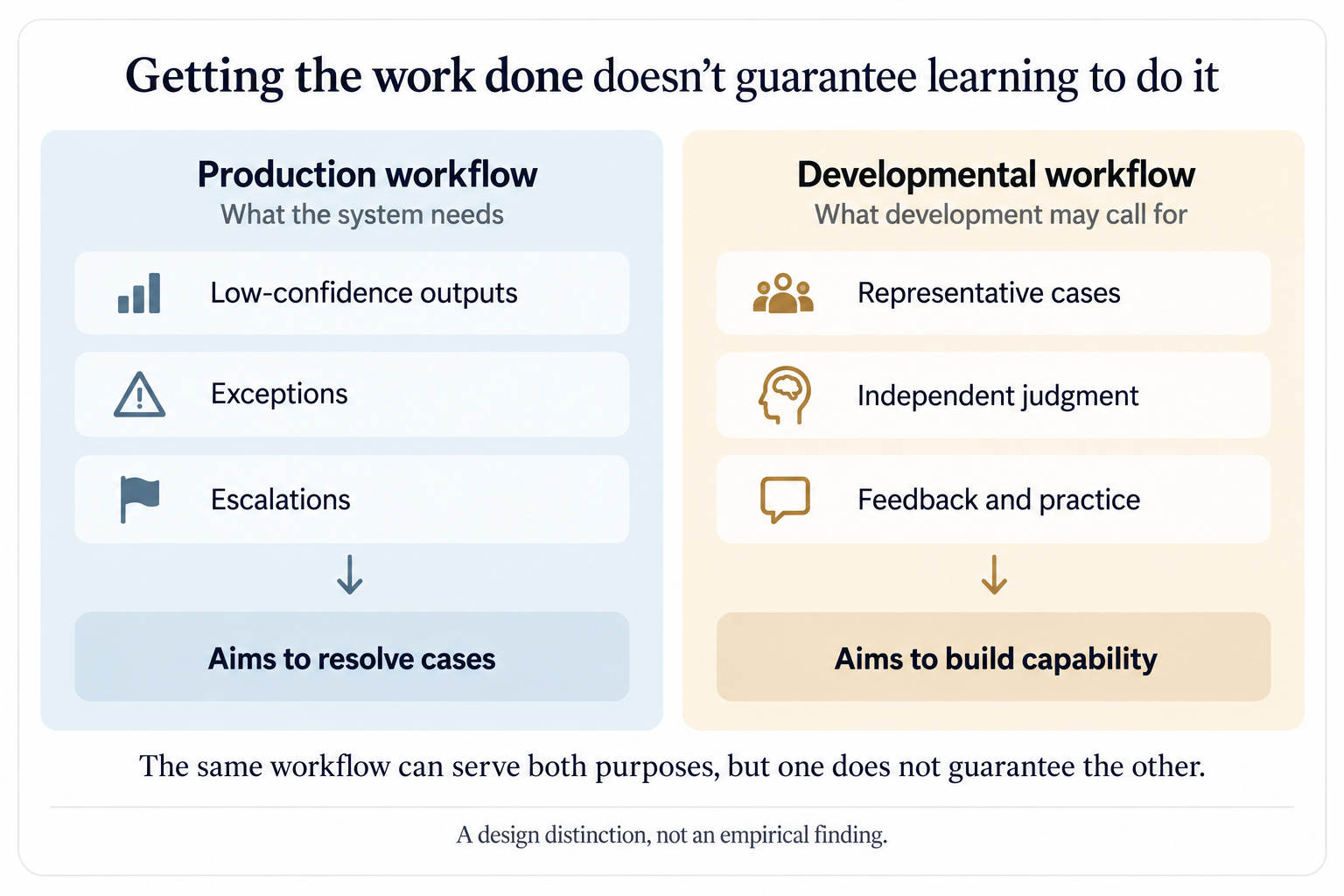
Production systems distribute work according to what the system needs. Low-confidence outputs, exceptions, escalations, unusual cases. The things the AI can't handle confidently enough on its own. But those aren't necessarily the cases a person needs to see to become good at the job.
Consider radiology. In a randomized trial, residents trained on sets containing different proportions of abnormal cases: 30, 50, or 70 percent. Their overall accuracy was similar, but their sensitivity to abnormalities differed. The more abnormal cases they encountered, the better they became at detecting them. What you see tunes what you become good at.
Now imagine that the cases reaching a human reviewer are determined by what an AI system considers difficult. As the system improves, that selection changes. Someone could become very good at identifying the particular failures their AI tends to produce while losing exposure to the ordinary cases that establish what normal looks like. They might be highly effective within that review workflow without developing the broader understanding the profession requires.
I haven't found research demonstrating that this happens in AI oversight. But the mechanism is plausible, and it raises a design question worth investigating. We know that case selection can affect what people learn. We also know that automated systems can determine which cases humans encounter. Whether those two facts combine to change the development of professional expertise is an open question.
There's another wrinkle. Even within a case, the AI may already have narrowed the evidence or discarded alternatives before the reviewer sees anything. A person can evaluate the presented output carefully without ever encountering the possibilities the system excluded. That matters because expertise isn't just recognizing errors in a proposed answer. It also involves knowing which alternatives deserve consideration, what evidence might be missing, and when the framing of the problem itself is wrong. We don't yet know whether AI-mediated review changes how those capabilities develop.
None of this means AI-routed review necessarily damages expertise. It means a queue designed to get work completed isn't automatically a good environment for developing the people doing it. Production routing optimizes for what the system needs from humans. Development requires thinking about what humans need to encounter.
Checking something isn't the same as learning from it
The obvious counterargument is that reviewing AI output provides plenty of experience. People see cases, identify mistakes, make corrections, and gradually become better at the work. That sounds reasonable, but it assumes that exposure and evaluation are sufficient for learning.
Research on learning from flawed examples suggests otherwise. Prior knowledge matters considerably. In one study, combining correct and incorrect worked examples improved far transfer for learners who already understood the domain, while making things worse for those who didn't. To learn from a mistake, you need some basis for recognizing it as a mistake, understanding why it happened, and reconstructing the correct approach.
That's particularly awkward for the apprenticeship question. The people who most need to develop expertise may be the least equipped to learn from checking someone else's work. An experienced professional can notice that an answer is technically correct but inappropriate for the circumstances. Someone still learning the domain may not even recognize that there's a distinction to make.
AI adds another complication: people don't always challenge its output the way they would challenge a human colleague's. In a preregistered experiment involving teachers, participants were less likely to correct excessively harsh grades when they believed AI had produced them. The effect was especially pronounced among younger, highly educated, technologically confident teachers. The assignment was still to exercise judgment, but the belief that AI had produced the grades changed how participants performed it.
There's also evidence that the order of judgment matters. In a separate randomized study involving 240 preservice teachers, participants who recorded their own judgment before seeing AI advice were more accurate when that advice was misleading (odds ratio about 1.9). That doesn't establish that making a judgment first develops expertise. The interventions differed in more than their order, and an unaided test roughly two weeks later was inconclusive. But it does suggest that how we arrange human participation can affect the judgment exercised during the task.
We also know from aviation that supervising automation doesn't necessarily preserve the skills involved in doing the work. In a study of experienced pilots, manual flying skills largely held up, but some cognitive skills showed more problems, including tracking position without a map display and recognizing instrument failures. Those difficulties were associated with how frequently pilots' attention wandered while automation handled the flying. This was a correlational study of experienced professionals maintaining skills, not novices developing them, but it illustrates an important distinction. Being present while a system performs a task isn't the same as practicing the capabilities that task requires.
That leaves us with a problem. We can't assume AI oversight becomes the new apprenticeship simply because people encounter large volumes of AI-generated work. The number of cases reviewed tells us very little about what the reviewer actually had to think through.
But evaluating work can teach you something
There's a substantial difference between passively approving output and actively figuring out what's wrong with it. Studying flawed solutions can produce real learning, sometimes even better conceptual understanding than solving problems independently. The important part is the cognitive work involved: identifying the error, explaining why it's wrong, and reconstructing the correct relationship.
And there's some direct evidence that evaluating AI-generated work can help.
In a 2026 randomized study involving roughly 640 Chinese undergraduates, researchers assigned students different ways of dividing report-writing work with AI. One group evaluated and revised complete AI-generated drafts. Another accepted or rejected AI-proposed edits. A third wrote drafts and received AI evaluation. There was also a no-AI comparison group. After four rounds of writing, the students completed assessments without AI.
Those who evaluated whole AI drafts performed better on an unaided writing task than students who wrote without AI, by about a third of a standard deviation. They also detected more planted errors in a separate AI-generated report: approximately 61 percent versus 51 percent. The other arrangements produced different results. Accepting or rejecting AI edits improved writing but not error detection, while having AI evaluate student-written drafts produced no measurable advantage over writing alone.
The study doesn't isolate which particular feature caused the difference, because the arrangements varied in more than one way. Evaluating a complete draft may have involved something different from approving individual edits, but the study can't say what.
There's an especially interesting detail. Among the roughly one-third of students most inclined to delegate judgment to AI, the whole-draft evaluation advantage wasn't detectable. Their interaction logs also showed more requests for the model to make judgments they were supposed to make themselves. That doesn't prove delegation caused the missing benefit, but it exposes a problem with how we think about human oversight: you can assign someone the task of evaluating AI output without ensuring they're doing the thinking.
I wouldn't make sweeping claims from this study. The participants were university students, the assessment happened immediately afterward, and the comparison was against working without AI rather than receiving good human feedback. We don't know whether the gains lasted, transferred to professional settings, or would appear under different evaluation arrangements.
Still, the result challenges the assumption that evaluation is inherently empty work. Some forms of evaluation may develop capability. Others may simply move responsibility onto a person without requiring much judgment at all. The difference isn't necessarily visible in the finished output.
The system can improve while the person doesn't
When someone catches an AI error, that correction can become useful information for improving the system. The organization can track it, categorize it, update instructions, change routing rules, or use it to improve future model behavior. But what did the person learn?
Those are two separate outcomes, and improving one doesn't guarantee improvement in the other. A workflow can become increasingly effective at capturing human corrections without the humans making those corrections becoming more capable themselves.
We've already seen how misleading assisted performance can be. In a field experiment involving nearly a thousand high school math students, access to a standard GPT interface improved performance on practice problems. Once the AI was removed, however, those students scored about 17 percent below students who had never used it. A version of the tool designed to withhold answers prevented that decline but didn't produce a measurable learning gain. Students also overestimated what they'd learned.
That experiment examined AI assistance rather than AI oversight, so it doesn't tell us whether reviewing AI-generated work would produce the same result. What it does demonstrate is that successful performance with AI can conceal what the person can actually do independently.
The results aren't uniformly negative. In a registered randomized experiment involving 211 undergraduates, access to AI improved immediate unaided knowledge-test performance by about 0.27 standard deviations. About three-quarters of the advantage remained a week later: 5.1 percentage points compared with an immediate gain of 6.7. Students who used AI to explain concepts also appeared to do better on delayed essay assessments than those who used it to produce writing. That usage comparison was observational, not randomized, so it doesn't establish why. [Contractor & Reyes, 2026]
There's encouraging evidence involving novices, too. In two preregistered studies, medical master's students without radiology training learned to assess lung nodules on CT scans. Compared with students who never received AI assistance, those who used AI only during a short training workshop scored approximately 3-4 percentage points higher on later unaided cases, although one confidence interval touched zero. Students who received AI assistance during the first half of practice scored about 10 points higher during the unaided second half. [He et al., 2026]
These students were making their own diagnoses with AI support, not reviewing AI-generated diagnoses for errors, and the studies were short. Nevertheless, the findings matter because they complicate the assumption that AI necessarily undermines novice learning. Under some conditions, AI assistance can support the development of independent capability.
Taken together, the evidence suggests that the relationship between AI use and learning depends on what the person already knows, what the AI is doing, and which parts of the thinking remain with the human. It doesn't establish which design would work best for professional oversight, but it does point toward a more useful measure of success than output quality alone: what can the person do afterward, without AI, that they couldn't do before?
That's the outcome I'd want to measure in any workflow supposedly developing human expertise.
What happens when we look at professionals?
Unfortunately, the evidence gets thinner right where the question becomes most consequential. I couldn't find a study directly testing whether structured evaluation of AI output develops professional expertise, let alone whether any improvement lasts. There are studies of adjacent activities, though, and they're worth examining.
One preregistered trial followed 133 patent lawyers who were randomized to use an AI drafting assistant for three months or work without it. At the end, participants evaluated a flawed AI-drafted patent application without assistance. Senior lawyers who had used AI scored about 0.45 standard deviations higher than controls. Junior lawyers showed no average improvement, although their individual results varied and they reported substantially greater satisfaction with the experience.
That's intriguing alongside the research on prior knowledge. Perhaps experienced professionals can use AI assistance in ways that strengthen their judgment while less experienced professionals struggle to extract the same benefit. But the trial doesn't establish that explanation. It's a Google-funded working paper, about a third of participants didn't complete the unaided assessment, and the junior sample was small. More importantly, the intervention was AI-assisted drafting, not a deliberately designed evaluation workflow. There was no later test of whether any gain persisted.
Evidence pointing in the other direction comes from colonoscopy. In an observational before-and-after study involving 19 experienced clinicians, unaided adenoma detection fell from 28.4 percent to 22.4 percent after AI assistance was introduced. The interpretation is contested, and the design can't establish that AI caused the decline.
These studies don't resolve whether evaluating AI output can build professional expertise. They show why we shouldn't assume either that AI assistance develops expertise or that it necessarily erodes it. And they leave the question of deliberate developmental design largely unanswered.
What if the AI learns faster than the human?
There's one further possibility that I find particularly interesting, although I haven't found direct evidence for it.
Imagine a reviewer encounters a novel AI failure. They investigate it, identify the problem, and correct it. The system incorporates that correction. Perhaps its instructions change, its retrieval improves, or the failure becomes recognizable enough to route differently. Now that particular failure stops appearing in the human review queue.
From a production perspective, that's success. The system is making fewer mistakes, and the humans supervising it have less work to do.
But from a developmental perspective, something else may have happened. An opportunity to encounter and understand that failure has disappeared from the work future reviewers see. The system has retained the lesson, but has the organization ensured that its people will?
Maybe new failures appear frequently enough to provide equivalent experience. Maybe the reviewers already know enough that it doesn't matter. Maybe deliberately constructed practice could replace the lost exposure. Those are empirical questions, and I don't have evidence that this dynamic is actually eroding expertise.
But it's another reason to be careful about treating oversight purely as a mechanism for improving AI. There are potentially two learners in the workflow, and we may be designing primarily for one of them.
The work was doing more than producing output
This brings me back to the routine work we're automating. Historically, a lot of professional development happened because people were doing productive work. They encountered ordinary cases, made decisions, received corrections, observed experienced colleagues, and gradually handled more difficult situations. That didn't mean production alone created expertise. Feedback, supervision, explanation, and practice mattered too. But production supplied many of the experiences around which that learning happened.
Automation can separate the output from those experiences. It's the kind of problem I use the Hidden Function Audit to examine: what else does this work accomplish that nobody explicitly assigned to it? If a task disappears, the output may still be produced. That doesn't mean every other function the task served has been preserved.
Other professions have already had to deal with versions of this problem. Aviation regulators recommend deliberate manual-flying practice and training for unusual automation situations, precisely because automation can reduce opportunities to exercise important skills. In interventional radiology, advances in imaging eliminated some diagnostic procedures that had traditionally provided residents with training opportunities. Simulation became one way to replace the lost experience.
Neither example proves that a particular AI oversight design will work. But both illustrate that maintaining expertise can require deliberately recreating experiences technology has made unnecessary for production.
And that has a cost. Someone has to allocate time for representative cases, explanation, feedback, supervised practice, and opportunities to work without the tool. From a narrow efficiency perspective, some of that activity looks wasteful. Why have someone do work the machine could complete faster?
Because producing the output isn't necessarily the only thing the work was doing. Organizations that eliminate the activity without replacing its developmental function may simply be booking the decay as a gain. That's the risk I'm concerned about, not an outcome the research has established.
So is botsitting actually useful?
Sometimes, probably not. If someone's job is to click through machine-generated output, catch obvious mistakes, and keep the queue moving, there's no particular reason to assume they're developing expertise.
But I don't think the opposite assumption holds either: that evaluating work is inherently less developmental than producing it. The evidence on learning from flawed examples suggests otherwise. The randomized AI-writing study provides narrow, direct support. The broader research on AI-assisted learning suggests that what the human actually does matters.
What we don't have is convincing evidence that ordinary AI review workflows reliably develop the professional judgment they'll eventually depend on. And that's the part I think organizations need to take seriously.
A production workflow needs to get the work done. A developmental workflow needs to expose people to the experiences that build capability. Sometimes those goals may align. Sometimes they won't. If AI removes routine work from the path to expertise, we need to figure out what that work was teaching and whether the activities replacing it can teach some of the same things.
Otherwise, we risk designing human-in-the-loop systems that depend on expertise while quietly eliminating the experiences that produce it.
The question isn't just where the human belongs in the workflow. It's what experiences that person still needs to become the human we'll eventually need there.
What the evidence doesn't establish
- That reviewing AI output can replace apprenticeship, or that the immediate gains in the student AI-evaluation experiment persist or transfer to professional work.
- That the teacher judgment-first experiment demonstrates lasting learning. Its unaided follow-up was inconclusive, and the interventions differed in more than presentation order.
- That AI-assisted drafting develops durable professional expertise. The patent-lawyer study measured unaided performance at the end of the intervention, not retention over time.
- That novices can develop expertise through reviewing AI output alone. Some novices benefit from AI-assisted practice, which is a different activity.
- That AI-routed queues or AI's filtering of alternatives actually distort professional learning. Those are mechanisms to investigate, not established effects.
Sources
- Große and Renkl (2007), learning from incorrect solutions
- Casner et al. (2014), Human Factors
- "Why do experts miss AI's errors?" (2026), PNAS Nexus
- Fan and Chang (2026), Behavioral Sciences
- Pusic et al. (2012), Medical Education
- Bastani et al. (2025), PNAS
- Contractor and Reyes (2026), IZA DP 18792
- He et al. (2026), "Predictive AI can support human learning while preserving error diversity," INSEAD working paper
- Autor et al. (2026), AI assistance and expertise in patent law, working paper
- Budzyń et al. (2025), The Lancet Gastroenterology & Hepatology
- Yan (2026), Frontiers in Psychology
- FAA Advisory Circular 120-123
- "Using simulation for interventional radiology training" (PMC)