AI Costs Are Often Ambiguity Costs
AI cost is often the price tag on ambiguity your organization never resolved.
Definition
Ambiguity cost is the operational cost generated when an AI-enabled workflow must interpret criteria or information that remain underspecified.
These costs can appear as additional context, retrieval, validation, escalation, or rework. They do not prove that organizational ambiguity is the cause: inefficient models, poor architecture, unnecessary calls, and other technical problems can produce similar costs. But when cost repeatedly accumulates around interpretation, it creates an economic trace worth investigating.
Cost can be evidence, not just overhead.
Mechanism
AI Cannot Ignore Ambiguity establishes the upstream problem: work that organizations leave underspecified still has to be interpreted when AI participates in producing an outcome.
This framework begins with what happens next.
That interpretation creates operational activity. The system may need additional context, retrieve more sources, encode exceptions, run validation, escalate uncertain cases, or correct outputs after the fact.
Operational activity creates an economic trace.
When that trace becomes expensive, the obvious response is to optimize the AI: use a cheaper model, reduce context, cut retrieval calls, tighten prompts, or automate more validation. Sometimes that is exactly the right response.
But optimization can also reduce the cost without resolving the condition producing it. If repeated retrieval exists because authoritative information is fragmented, fewer retrieval calls do not establish which source should govern. If validation repeatedly catches inconsistent outputs because the underlying criteria are underspecified, cheaper validation does not make those criteria clearer. If humans repeatedly handle exceptions because decision boundaries were never defined, reducing escalation costs does not establish those boundaries.
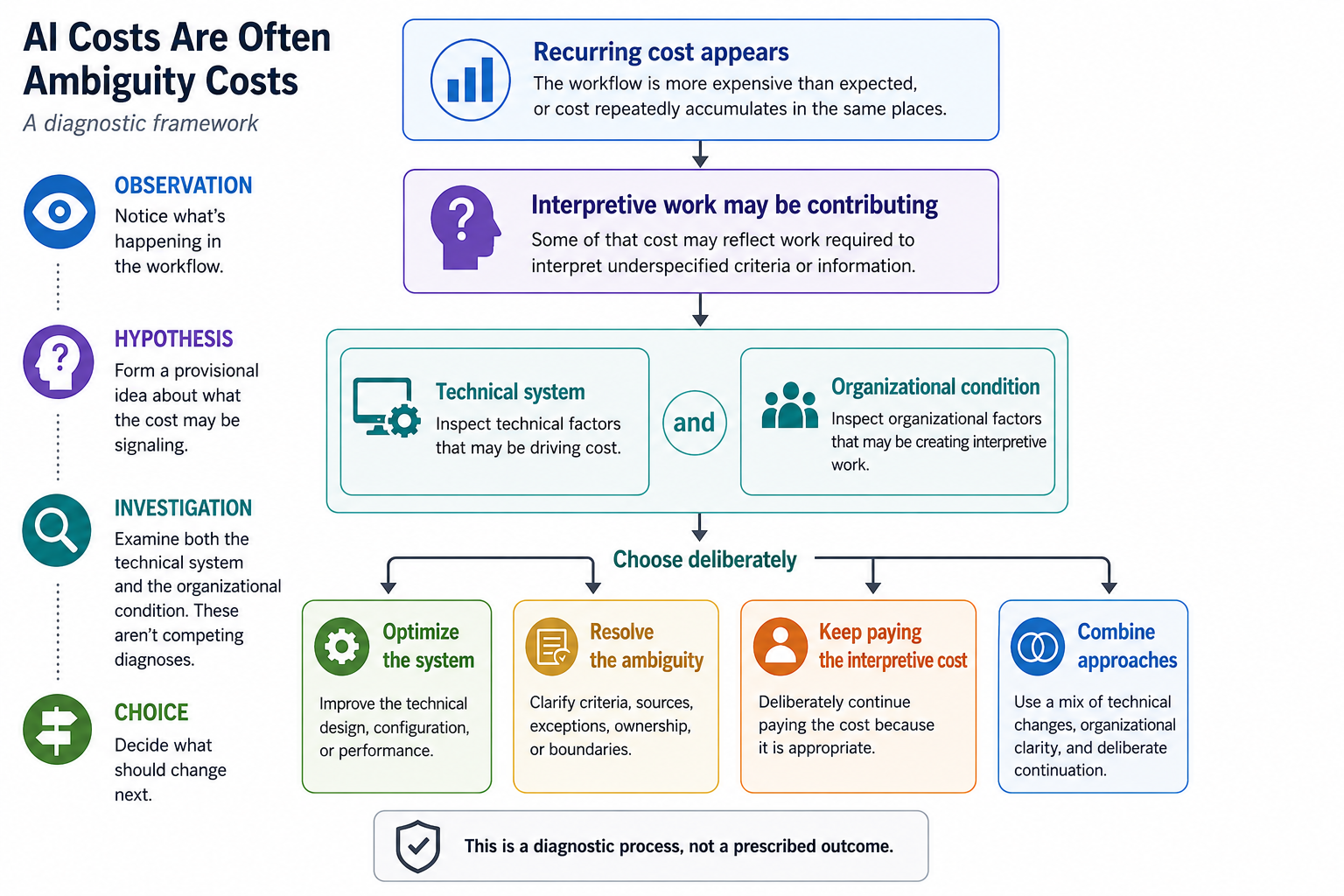
The important shift is therefore interpretive: before treating cost solely as something to eliminate, ask what work is generating it.
An expensive AI workflow may be telling you something about the AI system. It may also be telling you something about the organization around it.
Observable indicators
Ambiguity cost is worth investigating when operational expense repeatedly clusters around interpretation rather than straightforward execution.
- Context keeps growing to make the same kind of decision. Prompts, retrieved material, examples, or instructions expand because the workflow repeatedly needs additional information to determine what should happen.
- The same categories of output require repeated validation. Human review is not merely checking accuracy; reviewers repeatedly have to interpret what the correct outcome should have been.
- Exceptions accumulate faster than they resolve. New rules, overrides, and special cases are added because the underlying decision boundary remains difficult to state consistently.
- Escalations concentrate around the same unresolved questions. Humans are repeatedly pulled back into the workflow not because the system failed technically, but because someone has to decide which criterion, source, or exception should govern.
- Technical optimization lowers cost without reducing interpretive work. The workflow becomes cheaper or more efficient to run, but the same validation, exceptions, disagreements, or escalations continue elsewhere in the process.
No single indicator establishes ambiguity as the cause. The stronger signal is recurrence: the workflow repeatedly spends resources resolving the same kinds of organizational questions.
Applications
Hiring
A company introduces AI into first-pass candidate screening using criteria such as relevant experience, technical background, leadership, cross-functional experience, and sound business judgment. The criteria appear sufficiently clear until the system has to apply them consistently. Does four years in a highly relevant role outweigh six years in an adjacent one? Does founding a function demonstrate leadership without direct reports? What evidence demonstrates sound business judgment? The resulting cost may appear as additional examples, repeated validation, exception rules, and escalation to recruiters or hiring managers. Those costs do not necessarily mean candidate screening is a poor use of AI. They may be an economic trace of decisions the hiring process was already making without having fully specified them.
Customer support
An AI support agent is expected to answer customer questions and resolve routine cases using product documentation, support policies, and account information. Costs begin accumulating around cases where those sources disagree or leave room for interpretation. The documentation says one thing, an internal support policy adds an exception, and experienced agents know that certain customers or circumstances are handled differently. The system responds by retrieving more material, carrying more context, invoking additional checks, or escalating the case to a human. Reducing retrieval or using a cheaper model may lower the cost of the workflow. But if the same cases continue to require interpretation because the governing source or exception remains unclear, the organization has learned something beyond how expensive its support agent is to run.
Software delivery
An AI coding agent can generate a technically valid implementation and still encounter ambiguity about what the organization actually wants shipped. Requirements may leave edge cases unresolved. Architectural guidance may conflict with conventions in the existing codebase. Acceptance criteria may specify expected behavior without establishing which tradeoffs should govern when requirements collide. The economic trace can appear as additional repository context, repeated test-and-revise cycles, review comments, regenerated implementations, or escalation to engineers who know which convention should win. Optimizing the agent may reduce inference or context cost. Resolving the underlying decision may eliminate entire cycles of interpretation.
Across all three cases, the pattern is the same: the useful question is not simply how much the AI costs, but what the organization keeps paying it — or someone around it — to interpret.
What this framework is not
This is not a framework for identifying every source of AI cost. Model choice, token usage, latency, retrieval architecture, infrastructure, and workflow design all have their own economics. High AI spend is not, by itself, evidence of organizational ambiguity. Traditional cost optimization remains useful when the cost is primarily technical.
It is also not an argument that organizations should eliminate ambiguity everywhere. Some work genuinely requires judgment. Some decisions depend on context that cannot or should not be reduced to exhaustive rules. The goal is not to specify every possible case in advance.
And ambiguity cost is not necessarily waste. An organization may deliberately choose human escalation, additional validation, or richer context because resolving the underlying ambiguity would be more expensive, less flexible, or simply not worth doing.
The framework makes a narrower claim: when interpretive work creates recurring cost, treat that cost as information before deciding whether to optimize it away.
Otherwise the framework quietly becomes prescriptive — ambiguity → cost → fix the ambiguity. But the actual framework is diagnostic — interpretive cost → possible economic trace → investigate the underlying condition → then decide what deserves intervention.
Sometimes the rational answer may genuinely be, yes, keep paying the ambiguity cost. That's especially plausible for low-frequency exceptions, decisions where contextual judgment is valuable, or areas where formalizing every boundary would cost more than the interpretation itself.
Related frameworks
AI Cannot Ignore Ambiguity
This is a required predecessor to AI Costs Are Often Ambiguity Costs. It explains the upstream structural condition: AI-enabled production cannot rely on organizational ambiguity remaining tacit in the same way human workflows often can. AI Costs Are Often Ambiguity Costs begins with that premise and asks what happens economically when the resulting interpretive work becomes operationally visible.
The Proxy Was the System
Proxy Was the System explains what happens when an organization mistakes an observable proxy for the underlying function it was meant to represent. The frameworks intersect when an AI workflow repeatedly spends resources interpreting criteria that turn out to be proxies rather than explicit definitions of the underlying decision. Ambiguity cost can make that weakness economically visible; Proxy Was the System explains why repairing the proxy alone may not repair the function.
Human-in-the-Loop Is Not a Strategy
Human-in-the-Loop Is Not a Strategy examines whether human review actually provides the oversight or verification an AI workflow is assumed to have. The frameworks intersect when ambiguity repeatedly routes work back to humans. AI Costs Are Often Ambiguity Costs treats recurring escalation as a possible economic trace worth investigating. Human-in-the-Loop Is Not a Strategy asks the separate question of whether those humans have the capacity, information, and decision structure required for that intervention to work.
Practical use
When an AI-enabled workflow becomes more expensive than expected, do not begin by assuming either that the model is inefficient or that the organization is ambiguous. Start with the work the cost represents.
- Where is cost accumulating? Is it concentrated in retrieval, context, validation, exceptions, escalation, rework, or somewhere else?
- What is expensive to interpret here? Where does the workflow repeatedly require additional information, judgment, or human intervention to determine what should happen?
- What remains unresolved? Is the workflow struggling with source authority, decision criteria, exceptions, ownership, or boundaries that the organization itself has not made clear?
- What happens when the AI is optimized? Does technical optimization remove the interpretive work, or does that work persist or migrate into human review, exceptions, escalation, or downstream correction?
- What should actually change? Is the right response to improve the technical system, resolve the organizational ambiguity, continue paying the ambiguity cost deliberately, or some combination of the three?
The goal is not to classify every dollar of AI spend. It is to notice when cost is carrying information about the work around the system, and to use that information before deciding what deserves optimization.