AI Rewards Confidence Before Correctness
Speed and confidence are rewarded. The cost of premature confidence is deferred and invisible.
Definition
Organizations often behave as though rewarding speed and rewarding correctness are the same thing — or close enough that one can stand in for the other. It isn't. The reward signal and the validation signal don't arrive on the same schedule, and an organization can only act on the one that's already in.
This framework doesn't argue that speed is the problem, or that organizations are cynically choosing momentum over quality. It argues that the ordering of two feedback loops — reward and verification — determines which behavior wins, regardless of anyone's intentions.
None of this is new. Organizations have rewarded confident promises over careful sequencing long before AI entered the picture. What AI changes isn't the existence of the gap — it's the width of it. A confident-sounding plan, report, or deliverable can now be produced faster and more convincingly than ever, while the work of actually validating it hasn't gotten any faster at all. The reward clock speeds up. The verification clock doesn't move. The exposure window widens.
Mechanism
The employee who delivers first looks productive. The team that ships fastest appears most effective. The manager who reports the biggest gains gets recognized. Whether those outputs were actually correct often isn't discovered until much later — after decisions have been made, customers have been affected, or downstream teams have built on top of them.
And sometimes it isn't discovered at all. If no one ever traces a later outcome back to the original decision, the organization never receives a correction signal. The rewarded confidence becomes precedent instead.
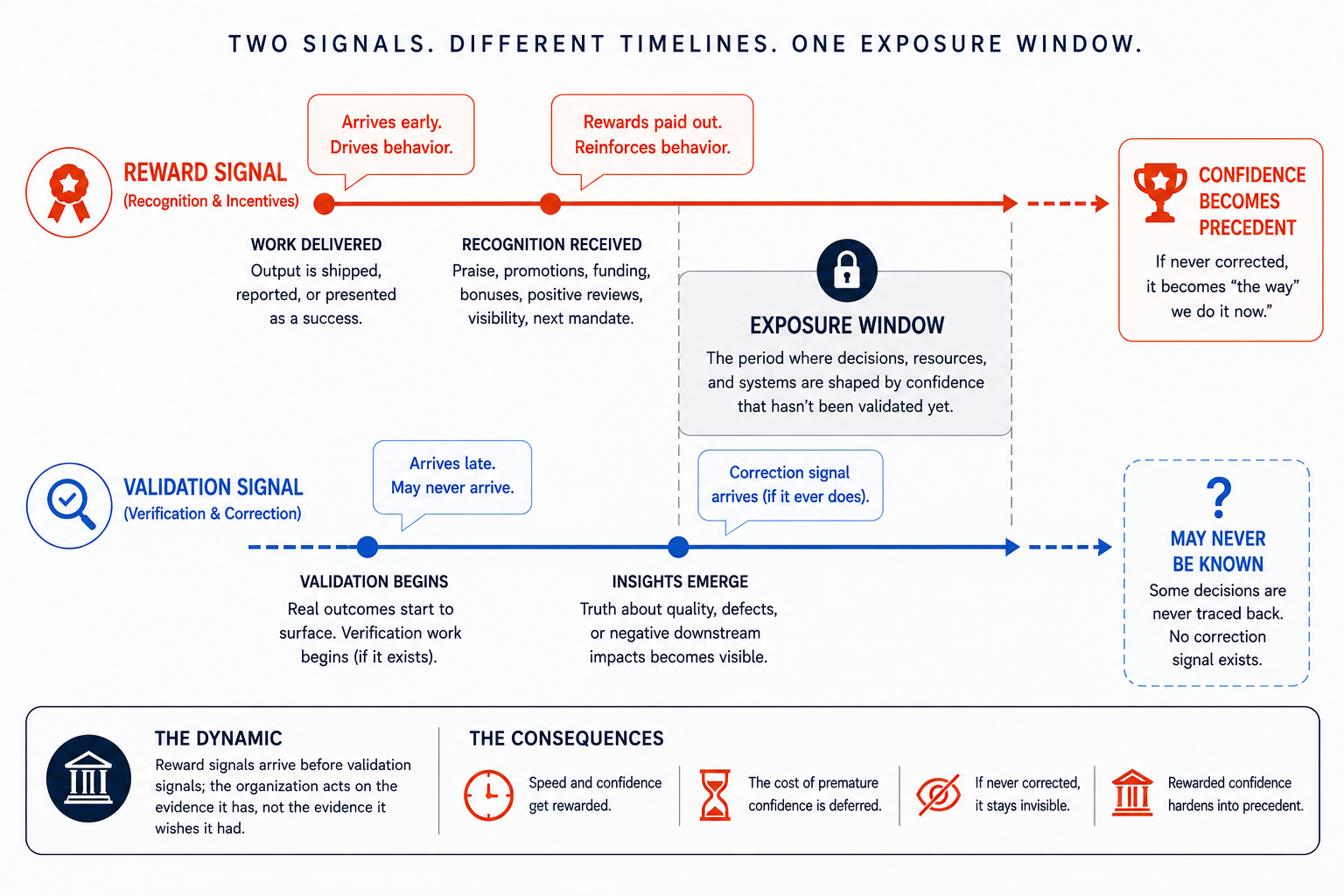
This is why verification becomes an organizational design problem rather than an individual responsibility. If the signals that determine promotions, recognition, and performance arrive before the signals that reveal quality, then speed and confidence will naturally outperform careful validation. People aren't necessarily optimizing for correctness. They're optimizing for what the organization measures first.
Organizations don't usually create cultures that reward being wrong. They create cultures where the rewards arrive before the evidence.
Observable indicators
- No one can name who would be told if a shipped decision were later found to be wrong
- Recognition, promotion, or performance review cycles run on a shorter timeline than the work's actual validation cycle
- Praise for a result routinely happens before anyone downstream has used or depended on it
- "Fast" and "good" are used interchangeably in retros and reviews, without anyone checking whether they were the same thing this time
- Past decisions that turned out to be wrong are still cited internally as examples of good work, because no one connected the two
Applications
Performance review cycles
A quarterly review credits an employee for shipping a feature ahead of schedule. Whether the feature actually held up is a question for a future cycle — one that may never explicitly revisit this decision or this employee's role in it.
Executive reporting
A leader reports strong adoption numbers for an AI-assisted process. The report influences funding, staffing, or future rollout decisions before anyone knows whether the underlying outputs were consistently correct. By the time meaningful validation exists, the organization has already committed to the direction.
Cross-team dependency chains
A downstream team builds on top of an upstream team's AI-assisted output, trusting that it passed review. If a defect surfaces months later, it's rarely traced back to the original delivery — it's absorbed as a cost of the system the downstream team is now working in.
Perceived competence and perceived resistance
In organizations where reward arrives before validation, the person naming a known dependency is often read as blocking progress, while the person promising past it is read as ambitious — at least until the gap between promise and delivery becomes impossible to ignore. The incentive structure doesn't just reward the wrong signal. It inverts which behavior looks like competence in the moment.
What this framework is not
This is not a restatement of individual overconfidence. Premature Operational Confidence explains why a person or team stops representing verification as pending — that's a cognitive-pressure mechanism at the individual and team scale. This framework stays at the organizational-incentive scale: it doesn't argue that people become psychologically overconfident, only that organizational measurement systems reward the behavior that overconfidence produces, before they can detect the behavior that careful validation produces.
It's also not a claim that speed itself is the flaw, or that organizations should simply slow down. An organization that rewards speed and has a validation signal arriving on a comparable timeline doesn't have this problem. The distinction that matters: it's not the presence of a speed incentive, it's the gap between when that incentive pays out and when correctness would actually be known.
And it's not a claim that AI created this dynamic. Reward signals have always outrun validation signals in organizations — long product cycles, long research timelines, and long career arcs all predate AI by decades. What AI changes is the cost of producing the confident-looking artifact that gets rewarded: that cost keeps falling, while the cost of independently validating it hasn't moved. The gap this framework describes isn't new. Its width is.
Related frameworks
Premature Operational Confidence
Premature Operational Confidence establishes the individual and team-level pressure: the "good enough to proceed" threshold gets crossed before the "known to be correct" threshold. This framework picks up at the organizational level — showing why the systems around that pressure don't correct for it, and often amplify it.
Human-in-the-Loop Is Not a Strategy
Human-in-the-Loop Is Not a Strategy explains why the organization's verification capacity fails to keep pace with production. This framework explains why the incentive structure keeps rewarding the behaviors that create that gap in the first place — the two describe the same organization from different angles: one is about capacity, this one is about what gets measured.
Practical use
When a process runs on "the team that delivers gets recognized," it's worth asking:
- What would have to happen for this decision's correctness to actually be checked, and on what timeline?
- If this later turned out to be wrong, is there a mechanism that would trace it back to the recognition it already received?
- Are we measuring the outcome, or measuring how quickly someone produced something that looked like the outcome?
- Has a past decision like this one become "the way we do it now" without anyone confirming it actually worked?
They surface whether the organization has any way of finding out — or whether today's rewarded confidence is on track to become tomorrow's accepted practice by default.
AI Rewards Confidence Before Correctness isn't a claim that organizations want to reward bad outcomes. It's a claim about what happens when reward signals arrive before validation signals. The organization acts on the evidence it has, not the evidence it wishes it had. And when verification never closes the loop, today's rewarded confidence becomes tomorrow's organizational precedent.